switchport mode is a Cisco IOS interface-configuration command family that sets a switch port’s administrative mode. The port’s operational mode is the mode it actually uses: access or trunk. section 13.1
Choose among four administrative modes:
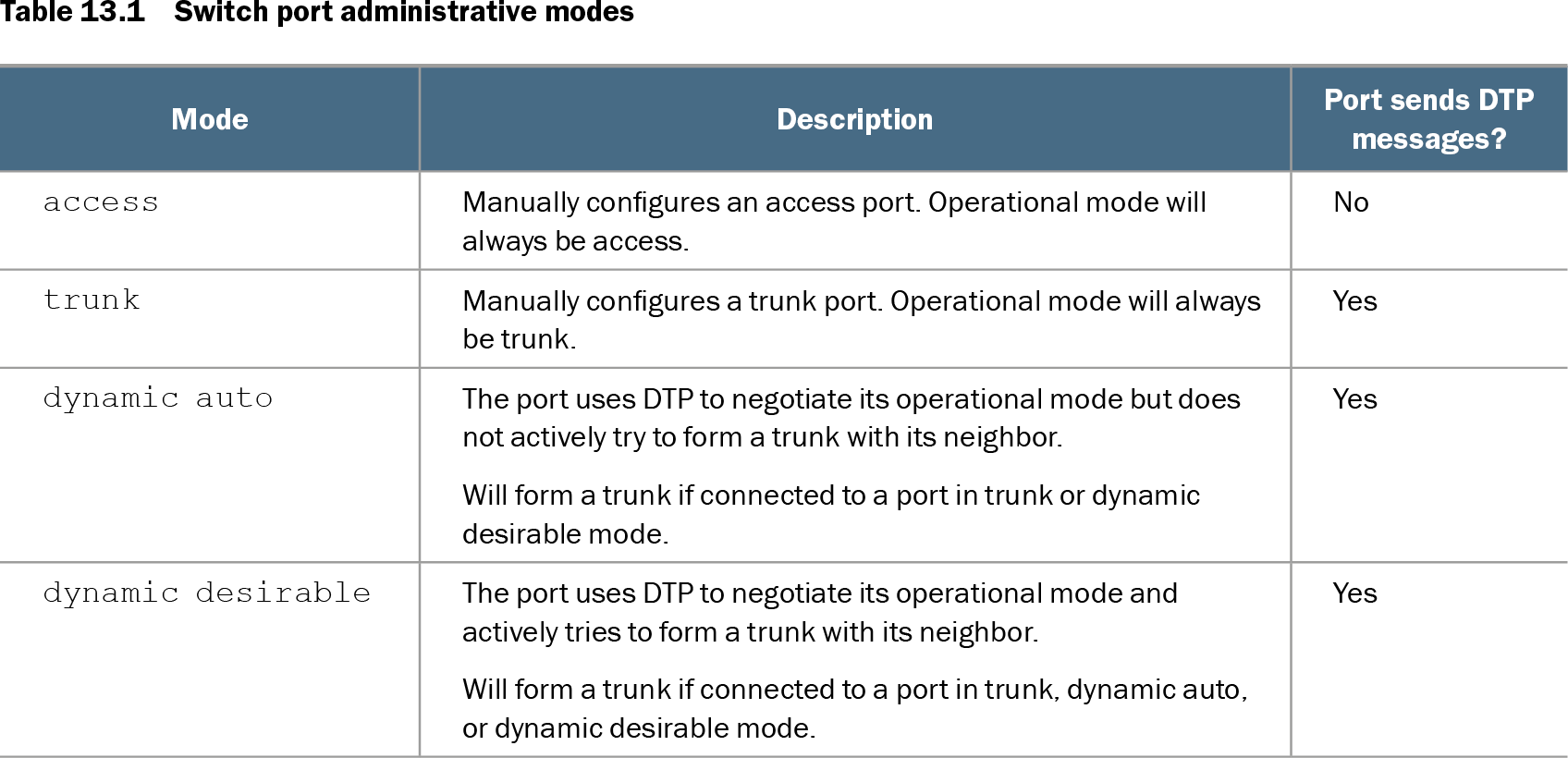
- access forces access operation and does not send DTP messages. section 13.1.1
- trunk forces trunk operation and sends DTP messages. section 13.1.1
- dynamic auto negotiates with DTP but does not actively seek a trunk; two default auto ports remain access ports. section 13.1.1
- dynamic desirable actively seeks a trunk and can form one with trunk, dynamic auto, or dynamic desirable. section 13.1.1
Verify the configured and operating modes
Use show interfaces g0/0 switchport. Administrative Mode: dynamic desirable and Operational Mode: trunk show that negotiation produced a trunk. With dynamic auto on both ports, the operational mode is static access. section 13.1.1
Table 13.1 Switch port administrative modes (view table figure)
| Mode |
Description |
Port sends DTP messages? |
|---|---|---|
| access |
Manually configures an access port. Operational mode will always be access. |
No |
| trunk |
Manually configures a trunk port. Operational mode will always be trunk. |
Yes |
| dynamic auto |
The port uses DTP to negotiate its operational mode but does not actively try to form a trunk with its neighbor. Will form a trunk if connected to a port in trunk or dynamic desirable mode. |
Yes |
| dynamic desirable |
The port uses DTP to negotiate its operational mode and actively tries to form a trunk with its neighbor. Will form a trunk if connected to a port in trunk, dynamic auto, or dynamic desirable mode. |
Yes |
Compare each administrative mode, its DTP behavior, and the neighbor modes that produce access or trunk operation. section 13.1.1