liveBook · Manning

Synchronous replication

As explained in 100 SQL Server Mistakes and How to Avoid Them

Synchronous replication propagates each data change to a secondary system and waits for its completion before completing the change on the primary.

Synchronous replication sends each write to a secondary system and waits for it to finish before completing the write on the primary. This prevents data loss during an unexpected failure, but network latency directly affects performance. section 13.1

Mistake: treating HA and DR as the same problem

Putting synchronous availability-group replicas in separate data centers may seem to provide both high availability and disaster recovery. Unless the sites have a very fast, low-latency connection, every cross-site write can slow the primary. Use synchronous replication where latency is acceptable; distinguish local automatic failover from cross-site disaster recovery. section 13.1

Figure 13.1 HA topology with availability groups providing automatic failover in a single site
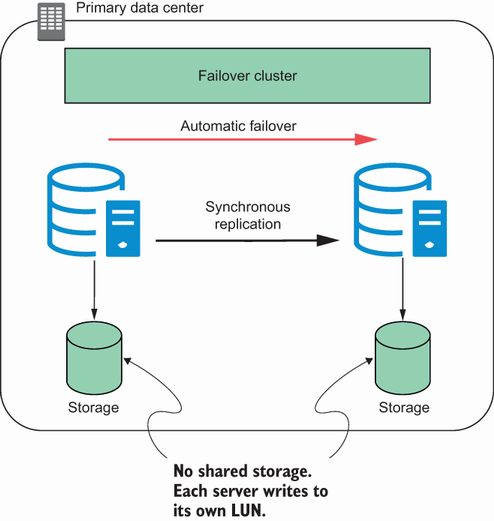
A local availability-group topology makes synchronous replication’s automatic-failover role concrete. section 13.1


How 100 SQL Server Mistakes and How to Avoid Them covers it

How deep it goes
Explains write acknowledgment and latency consequences, but stops short of configuration or diagnostic procedures.
Examples
Uses local availability groups and geographically separated data centers to contrast automatic failover with latency-sensitive replication.
What you can do after
Evaluate whether synchronous replication fits a topology by weighing data-loss protection against network latency and write performance.
How it connects
Connects availability groups with high availability, disaster recovery, read scaling, network latency, and traditional clustering.

Also explained in

Compare how 2 books explain synchronous replication →

Related concepts

This explainer was generated by Manning's knowledge graph from the text of 100 SQL Server Mistakes and How to Avoid Them. The section links point to the parts of the book it draws on.