How can someone check whether a passage or image was made by AI when it looks ordinary? SynthID is Google’s approach to placing an imperceptible watermark in generated content. Rather than judging whether finished content looks AI-made, watermarking adds a detectable signal when the content is created. section 6.9 section 4.4
SynthID-Text subtly adjusts a model’s word choices as it writes. Imagine some words being marked as “highlighted”: choosing them slightly more often leaves a statistical fingerprint across a passage. The pattern is meant to be detectable without being noticeable to a reader. In a large-scale test involving nearly 20 million Gemini chatbot responses, user feedback indicated that the watermark did not affect perceived quality or usefulness. section 6.9
Figure 6.9 How a language model uses highlighted word biasing to embed watermarks in the generated text
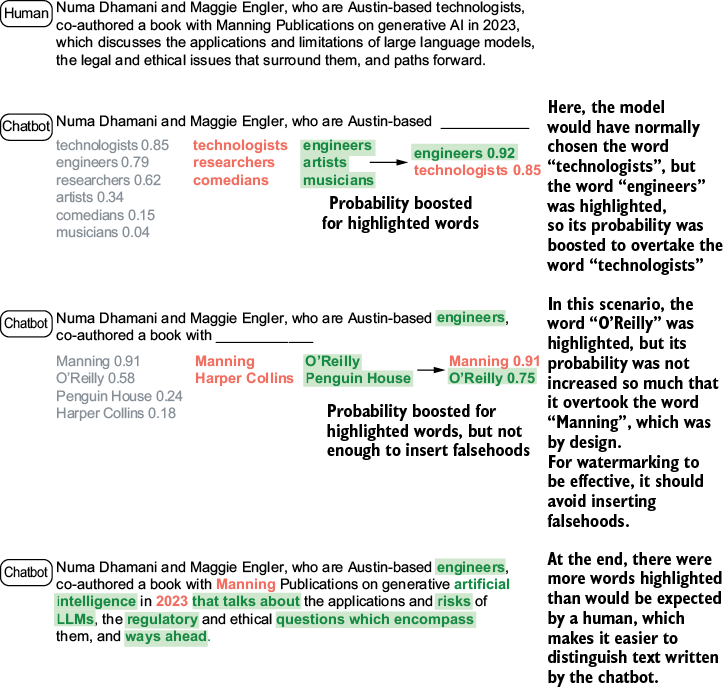
The highlighted-word diagram illustrates how small shifts in word choice can produce a detectable pattern without visibly marking individual words. section 6.9
The signal has limits. Paraphrasing or even minor edits can destroy a text watermark, and SynthID-Text requires cooperation from the model provider rather than working on any finished document. Image watermarking faces different edits: SynthID places signals in pixels and is designed to withstand some changes, but cropping, resizing, or compression can still degrade invisible watermarks. Detection may also require specialized tools. A watermark is therefore one aid to verification, not proof that all unmarked content is human-made. section 6.9 section 4.4
