A table-to-table join combines two changing table views into a new result. Unlike a stream-stream join, it has no window: an update on either side updates that table and can trigger a recalculated join result. A ValueJoiner computes the result and may return any value type. section 8.6.4
Choose the join form from the relationship between table keys:
- Primary-key join: join tables whose records use the same primary key. Their source topics must have the same number of partitions so matching keys are processed together. section 8.6.4 section 8.6
- Foreign-key join: use a field in one table’s value that matches the other table’s primary key. This supports relationships such as client contracts keyed by client ID and commodity prices keyed by commodity code. section 8.6.4
- ksqlDB foreign-key join: join a table’s primary key to a nonprimary-key column on the other table; joining against a value column removes the co-partitioning restriction. section 11.6
Reward activity counts by member
An activity-count table keyed by last_name can join a rewards-members table keyed by member_id through its last_name column. In ksqlDB, create the result table with a JOIN on those columns and EMIT CHANGES, so the joined table follows later changes. section 11.6
In Kafka Streams, a foreign-key join extracts the matching key from the left value and uses repartition topics to route lookup and result work. Processing also tracks the original value with a hash; after a right-side update, matching composite keys are scanned so all affected results can be produced. section 8.6.4
Figure 8.25 Left-side table in a table–table join is updated, and a new join result is triggered.
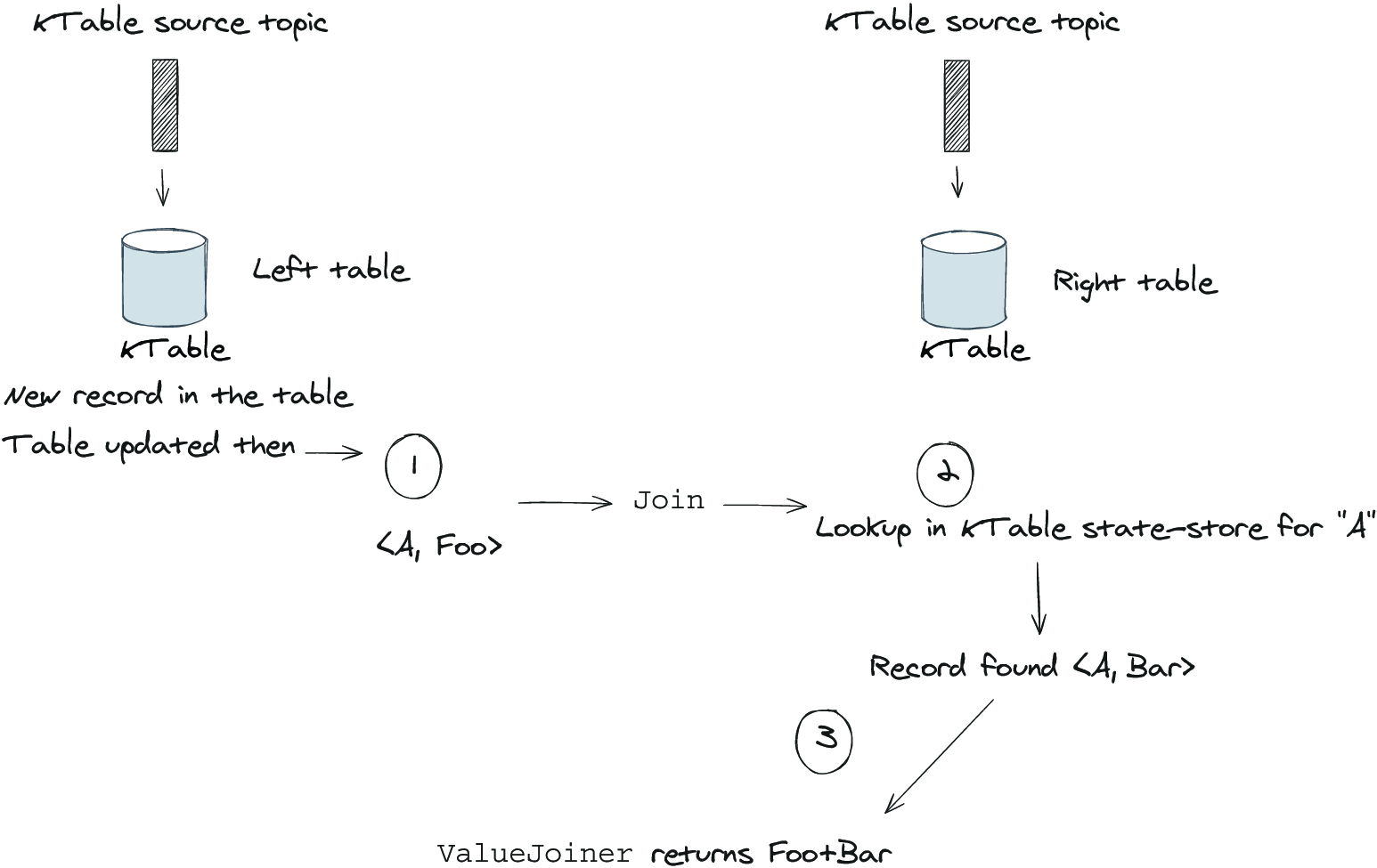
Inspect the left-side update path: updating one KTable first changes its state, then potentially emits a new joined result. section 8.6.4

