Tail at scale describes a fan-out request whose total latency is controlled by its slowest synchronous branch. Parallel work may be fast overall, yet one delayed dependency holds the response open and dominates high-percentile latency. section 9.5
Booking request with calendar and video providers
A booking request writes locally to Postgres in milliseconds, then waits synchronously for Google Calendar and Zoom before returning 201. The response remains blocked while either provider runs; the slowest provider determines the user's latency. Moving email, webhooks, and search indexing after the response separates asynchronous work from the critical path. section 9.5
Figure 9.8 A request trace before and after the 200 OK response. The left side shows the synchronous work the user waits for: web server calls to the cache, database, and external APIs. The right side shows the asynchronous work that runs after the response is sent: a queue fans out jobs to workers that send email, fire webhooks, and update the search index.
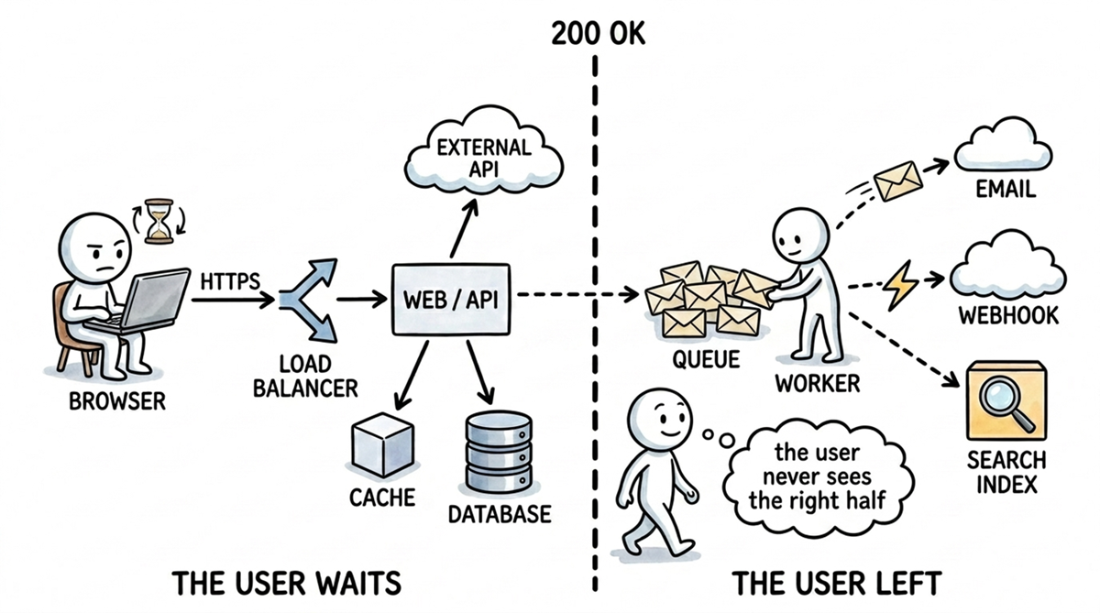
Trace the boundary between work the user waits for and queued work that continues after the response. section 9.5
