Task cancellation signals that ongoing work is no longer needed and should stop. In a Go service, a context carries that signal through the request call chain, allowing downstream goroutines, database operations, and HTTP calls to wind down instead of continuing after a client disconnects or deadline. section 1.4.3 section 1.4.2
Use cancellation to keep concurrent work bounded and responsive:
- Create a context with a timeout when the operation has a known time budget. section 9.3
- Pass contexts as values through function calls rather than embedding them in structs. section 9.3
- Derive contexts for groups of concurrent operations so one error can cancel the remaining work. section 9.3
- Call the cancel function when the operation ends, and use context for both cancellation and deadlines. section 9.3 section 9.6.1
Canceling concurrent feed fetches
A feed aggregator creates a 60-second context, passes it to each fetch, and derives an errgroup context. If one feed fetch fails, the derived context cancels the other requests; if the deadline expires, all downstream operations can return early. section 9.3
Figure 1.4 The life cycle of a single HTTP request
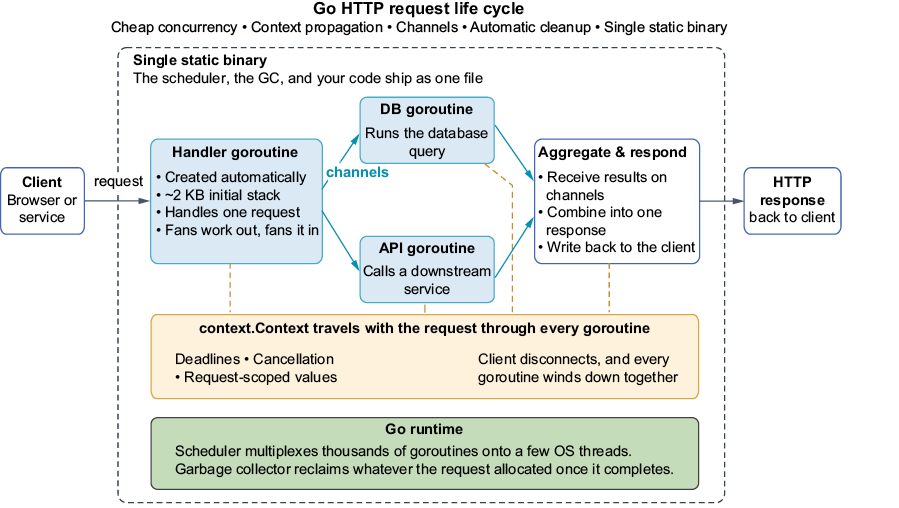
Trace cancellation from an HTTP client disconnect or deadline through the request goroutine and its downstream operations. section 1.4.3




