A task definition states what an AI system is expected to do, where its responsibilities stop, and what counts as success. A medical chatbot described as helping patients “manage their health” may be judged against personalized advice it was never designed or permitted to give. section 2.4.1
Two mismatches can distort evaluation. A scope mismatch expects a system to do more than its intended task; an equivalence mismatch treats similar-looking tasks as interchangeable, such as health education and medical triage. Vague correctness criteria create another problem: evaluators may disagree about whether an answer needs a safety warning or should avoid mentioning rare conditions. section 2.4.1
Check whether an evaluation dataset reflects the task you intend to assess:
- Compare task definitions, assumptions, edge cases, labels, and success criteria. section 4.5.1
- Inspect a diverse sample for situations your system must handle, including messy or emotionally loaded queries when relevant. section 4.5.1
- Test a baseline that reflects your intended behavior; poor dataset scores despite appropriate behavior can reveal a mismatch. section 4.5.1
Figure 2.3 Two common sources of task-definition failure. In a scope mismatch, the system is expected to perform tasks it was never designed to handle while in an equivalence mismatch, stakeholders assume that solving one task is equivalent to solving a different one.
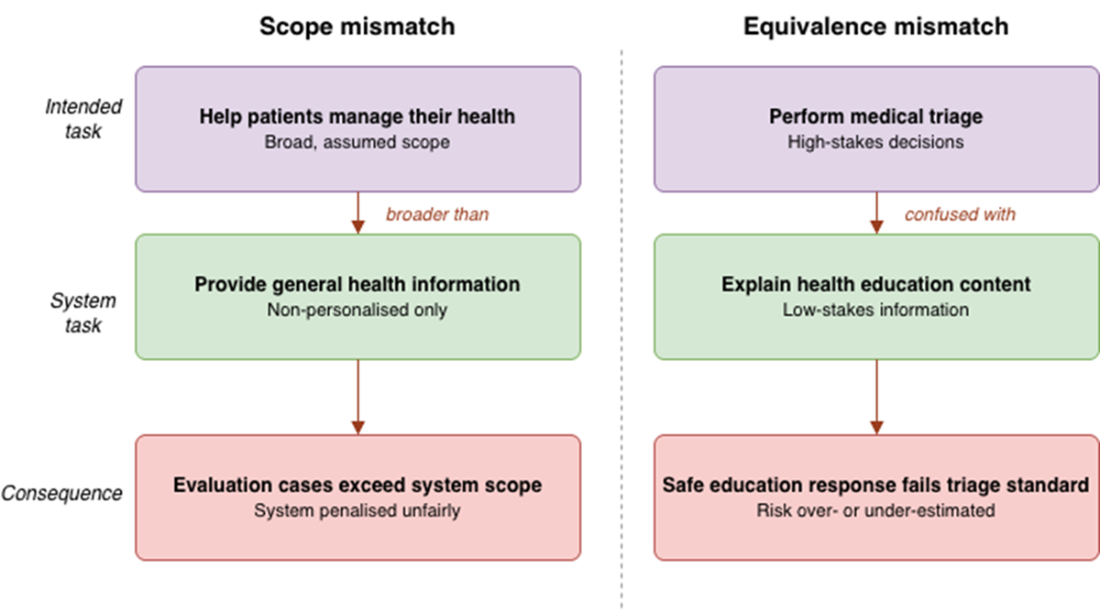
Use the comparison to distinguish systems asked to exceed their scope from systems evaluated as though they perform a different task. section 2.4.1
