Tax savings reduce a tax bill through tax-favored decisions, but their value depends on personal circumstances, account types, tax rates, holdings, costs, and timing. They are therefore best treated as estimates under explicit assumptions rather than as fixed promises. Automated analysis can use Monte Carlo simulation to estimate savings for a particular situation. section 1.2.2
A central form is tax-loss harvesting (TLH): realize a loss to offset tax currently owed, then reinvest the sale proceeds in a similar ETF so portfolio exposure does not change drastically. The immediate benefit is the applicable tax rate multiplied by the realized loss. This is usually tax deferral, not permanent elimination: selling the replacement investment later can create a larger taxable gain because its cost basis is lower. section 14.1.1 section 14.3.3
Deferring a $1,000 tax payment
An ETF bought for $100,000 falls to $95,000. At a 20% applicable tax rate, realizing the $5,000 loss produces a $1,000 tax benefit, offsetting a $1,000 tax bill and leaving $1,000 cash available to invest. Replacing the ETF preserves broadly similar exposure, but lowers basis to $95,000. If the replacement later sells for $150,000, the gain is $55,000 rather than $50,000, so the earlier benefit came from postponing tax. section 14.1.1
A harvesting decision must compare the apparent tax benefit with constraints and costs:
- Exclude lots whose sale and replacement would create a wash sale. section 14.3.3
- Calculate losses for sellable lots and rank them by tax benefit so the most valuable eligible losses are considered first. section 14.3.3
- Require positive benefit after trading costs and after opportunity cost before generating a trade. section 14.3.3
- Choose replacement ETFs carefully when several exchangeable ETFs and several loss lots are involved; buying an ETF planned for sale can itself create a wash sale. section 14.3.3
Tax-aware withdrawal sequencing can also create substantial savings during retirement decumulation. Possible approaches include spending taxable accounts first, spending retirement accounts first, withdrawing from an IRA up to a tax-bracket boundary, or making a Roth conversion while filling that bracket. Under a given set of assumptions, the best sequence can make assets last years longer, but the appropriate choice varies with the individual situation. section 1.2.2
Figure 1.1 Decumulating tax-efficiently can make your money last longer.
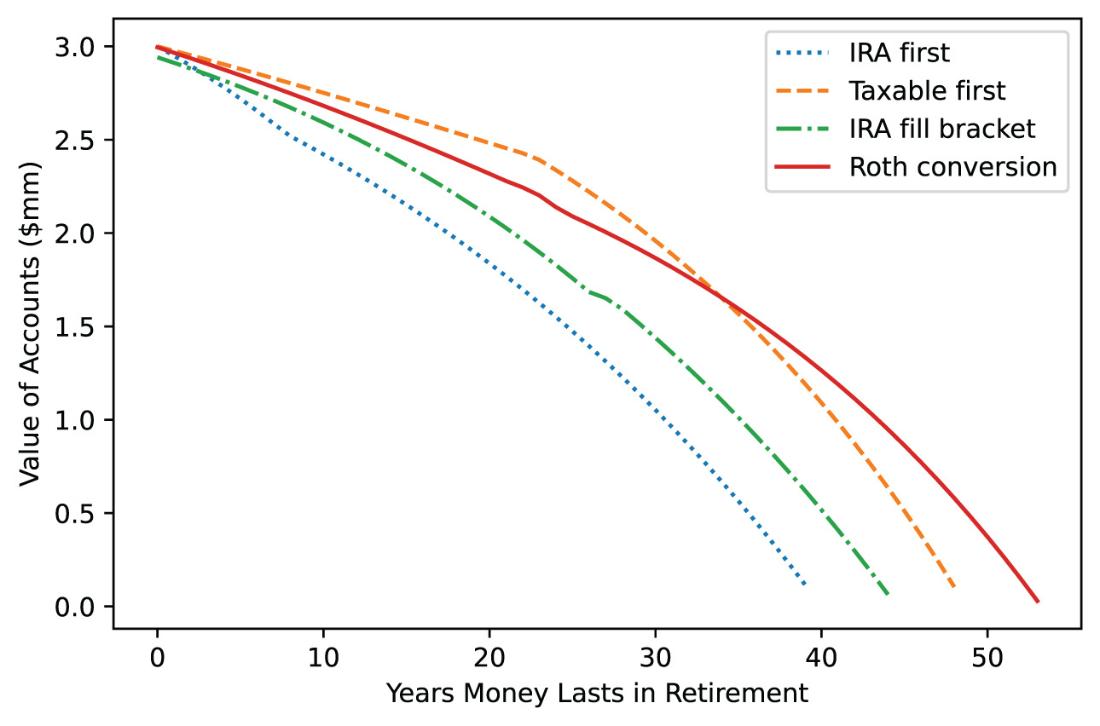
Compare the four withdrawal sequences by how long assets last under the illustrated assumptions; the figure emphasizes that sequencing can materially change a retirement outcome. section 1.2.2
