A technology stack upgrade updates a language, library, framework, platform, or tool used by an application component. The engineering challenge is not only changing the technology: it is limiting the work and coordination needed to deliver the change. section 5.3.3 section 5.3.4
Upgrades support feature development, keep the stack current, fix vulnerabilities, and enable low-cost, realistic experiments with new technologies. Emergency vulnerability fixes need to happen quickly. Feature-driven and routine upgrades risk being delayed when they create work for many teams. section 5.3.3
A framework upgrade in a monolith
An Orders team needs a Spring framework upgrade to implement a feature. Although its application code changes are confined to Order Management, the upgrade affects all 10 teams building the monolith. The other teams must investigate required changes, implement them, and verify their own subdomains. If coordination or scheduling prevents approval, the Orders team must work with the existing version. section 5.3.3
A multi-component architecture can reduce this coupling. An upgrade to a component-private stack element affects that component and the teams developing it. A change that affects every component can be made incrementally, one component at a time. A vulnerable library used by only some components needs upgrading only in those components. section 5.3.4
Figure 5.12 A multi-component architecture significantly improves an application’s evolvability. Upgrading the private elements of a component’s technology stack affects just that component and its team or teams. Typically, only upgrades of shared technology stack elements require many teams to collaborate.
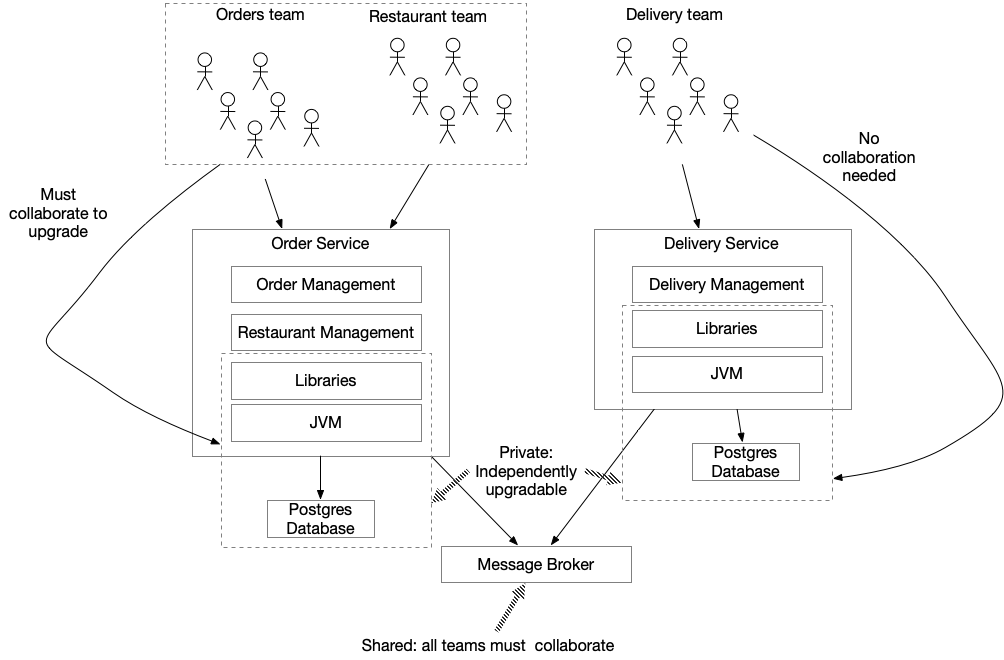
The figure distinguishes component-private stack elements from shared elements, showing where an upgrade affects one component or requires broader collaboration. section 5.3.4
The trade-off is repeated work: a library used by every component must be upgraded separately in each one. Shared infrastructure, such as a message broker, can still require coordination across teams. Splitting an application into services alone does not ensure easy upgrades; tight coupling and a lack of independent deployability can leave them difficult. section 5.3.4 section 2.2.4
When assessing an upgrade, identify which components use the affected element, which teams must agree, and whether the work can be done incrementally. Treat security urgency and the cost of repeated component-level changes as distinct concerns. section 5.3.3 section 5.3.4
