A temporal dependency, also called temporal coupling, exists when components must be online and responsive at the same time for an operation to succeed. A slow or unavailable component can make the whole synchronous process fail. section 7.1
A chain that falls together
An Order API calls Inventory, Payment, then Shipping. If Shipping is down, the purchase fails—even when inventory is available and payment is valid. It’s like a phone call: both parties have to be there at once. section 7.1
Asynchronous communication breaks the need to act at the same moment: a sender can publish an event while a receiver is unavailable and process it later. The tradeoff is a real gap between an event being sent and processed, so systems must allow for eventual consistency. section 7.9
Figure 7.2 Synchronous coupling requires both parties to be present. Asynchronous decoupling allows the receiver to sleep while the sender keeps working.
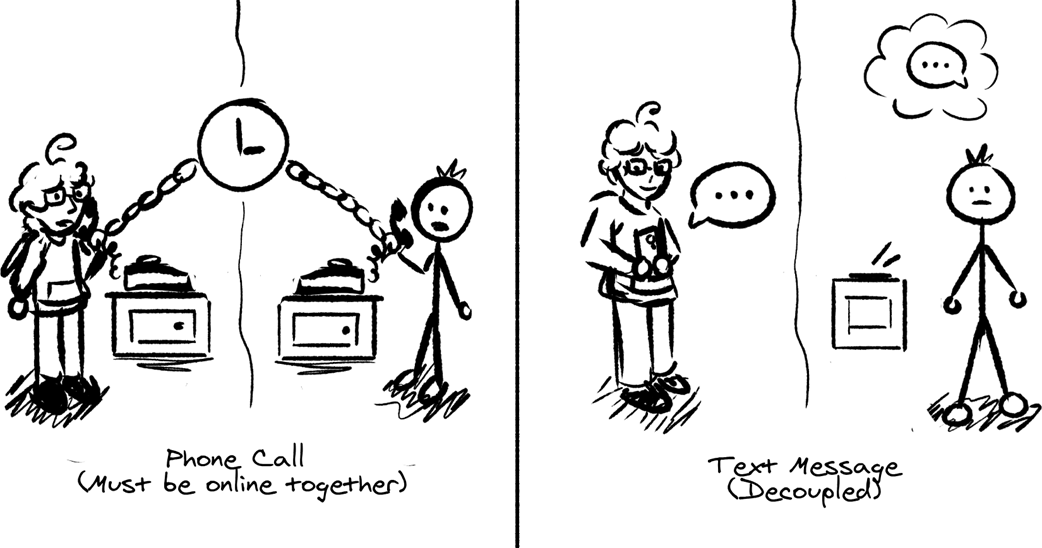
Compare synchronous communication, which requires both parties to be present, with asynchronous communication, which lets the receiver process work later. section 7.1


