liveBook · Manning

Tenant

As explained in Designing Deep Learning Systems: A guide for software engineers

A customer organization that uses a shared application while maintaining a separate account and segregated data.

A tenant is a company or organization using the same application or service as other customers while retaining a separate account and segregated data. section 6.3.2

In a multitenant chatbot, each tenant can train a model on its own dataset. Requests are routed to that tenant’s model, improving fit for its business situation. section 6.3.2

A shared model-serving design provides:

  • A model cache that keeps model graphs and dependent data in memory. section 6.3.2
  • A model file server that supplies the models used by the service. section 6.3.2
  • One prediction service capable of serving multiple tenant models of the same type. section 6.3.2

Tenant-specific intent classification

A school and a retail store share a chatbot application, but each has a separate account, dataset, and intent classification model. The application identifies the tenant and uses that tenant’s model for prediction. section 6.3.2
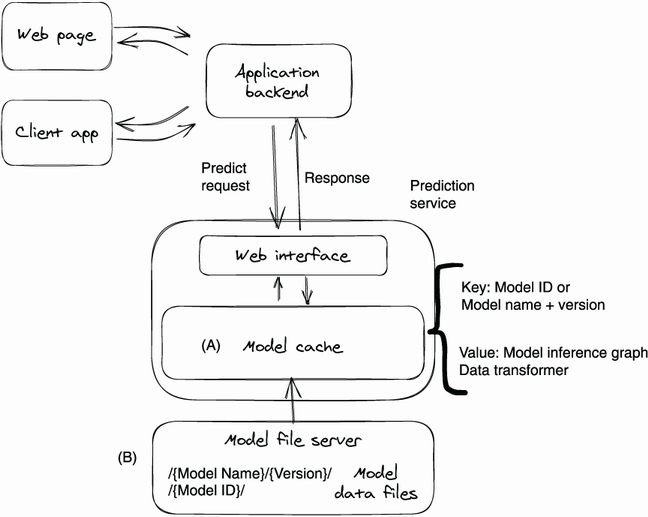
Figure 6.6 A prediction service with model caching for multitenant applications

Shows a prediction service using model caching to serve multiple tenant models. section 6.3.2

How Designing Deep Learning Systems: A guide for software engineers covers it

How deep it goes
Defines tenant identity and explains model routing, caching, and file serving without detailing implementation interfaces.
Examples
Uses schools and retail stores sharing a chatbot, separate datasets, tenant-specific models, and a cached prediction service.
What it assumes
Assumes familiarity with chatbot requests and intent classification while defining tenant accounts, data segregation, and model ownership.
What you can do after
Operate/configure a shared prediction service that selects tenant-specific models and caches their graphs and dependent data.
How it connects
Connects tenants with multitenancy, model serving, intent classification, model caching, and segregated data.

Also explained in

Compare how 4 books explain tenant →

Related concepts

This explainer was generated by Manning's knowledge graph from the text of Designing Deep Learning Systems: A guide for software engineers. The section links point to the parts of the book it draws on.


