A test environment is a configured layer for checking a system’s effectiveness, quality, functional performance, and production readiness. It sits between development and production, with pre-production sometimes added for regulatory or sensitive-data screening. section 2.7 section 8.6
Treat the test environment as an engineered delivery capability:
- Implement and commission the environment, then define functional tests, test data creation, and controls against data leakage. section 8.2
- Deploy a data pipeline, test harness or mock application, selected models, associated artifacts, and feedback collection. section 8.2.2
- Check credentials, permissions, component health, calibration or smoke tests, and pipeline ordering before executing tests. section 8.2.2
- Measure functional and nonfunctional performance with metrics suited to the context; accuracy alone may conceal important trade-offs. section 8.2 section 8.6
- Automate repeatable setup and execution where possible to protect test integrity and create accountable evidence for stakeholders. section 8.2 section 8.2.2
Promoting a model for testing
A team obtains access, deploys the test infrastructure, hydrates it through the data pipeline, runs smoke checks, executes the model tests, and records results before promotion toward production. Airflow or another shared orchestration engine can automate these steps. section 8.2.2
Figure 2.4 Environments for delivery; sometimes a pre-prod or staging layer that completely replicates production is also required.
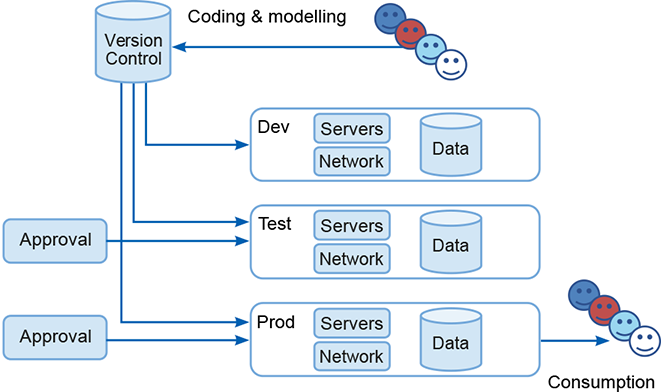
Use the environment map to compare development, test, production, and optional pre-production layers and their artifact flow. section 2.7



