A testable implication is an observable statistical consequence of a causal model’s assumptions. A proposed DAG can imply constraints on the joint distribution, which data can test rather than merely use for prediction. section 4.5
Testable implications arise in two closely related forms:
- Conditional independencies follow from d-separation. They can be tested when the required variables are observed. section 4.5 section 4.5.2
- Functional constraints can remain testable when some variables are latent, extending model checks beyond fully observed DAGs. section 4.5 section 4.5.2
- Unobserved variables reduce the available checks: a constraint involving an unavailable variable cannot be tested directly. section 4.5
Smoking, cancer, and unobserved genetics
A DAG for smoking and cancer includes tar buildup, lung cancer, smoking, and genetics. If genetics is unobserved, tests involving it are unavailable, but the model still implies the observable conditional independence (C ⊥ T | S). Functional constraints provide another route for testing the DAG despite the latent variable. section 4.5
Figure 4.20 A causal DAG representing smoking’s effect on cancer. The variable for genetics (D) is gray because it is unobserved in the data, so we can’t run tests for conditional independencies involving D. However, we can test other types of constraints.
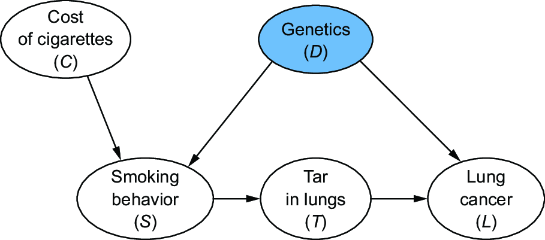
Use the DAG figure to distinguish observed variables from the gray latent genetics node and identify which model constraints remain testable. section 4.5
