The text/context layer (L1) is editable text that tells a model what to do on each call. It is shared agent infrastructure: changes are inherited by every instance. Rewriting this text is the cheapest, safest kind of change because it does not alter the agent’s structure. section 1.3.2
Common L1 artifacts include:
- Prompts: system prompts, message prefixes, and task instructions. section 1.3.2
- Tool descriptions: natural-language guidance the agent uses when choosing and calling tools. section 1.3.2
- Skill files: reusable text bundles of instructions, examples, and references. section 1.3.2
Context assembly rules also shape what reaches the model, but are treated as code in Layer four rather than as L1 text artifacts. section 1.3.2
Figure 1.8 The harness artifact layers of self-improvement. The frozen model (LLM) serves as the unchanging substrate below. The four artifact layers stacked on it are shared infrastructure, inherited by every instance of the agent. Layer zero is the toolkit, the engineering work that measures, searches, and applies, reused at every layer.
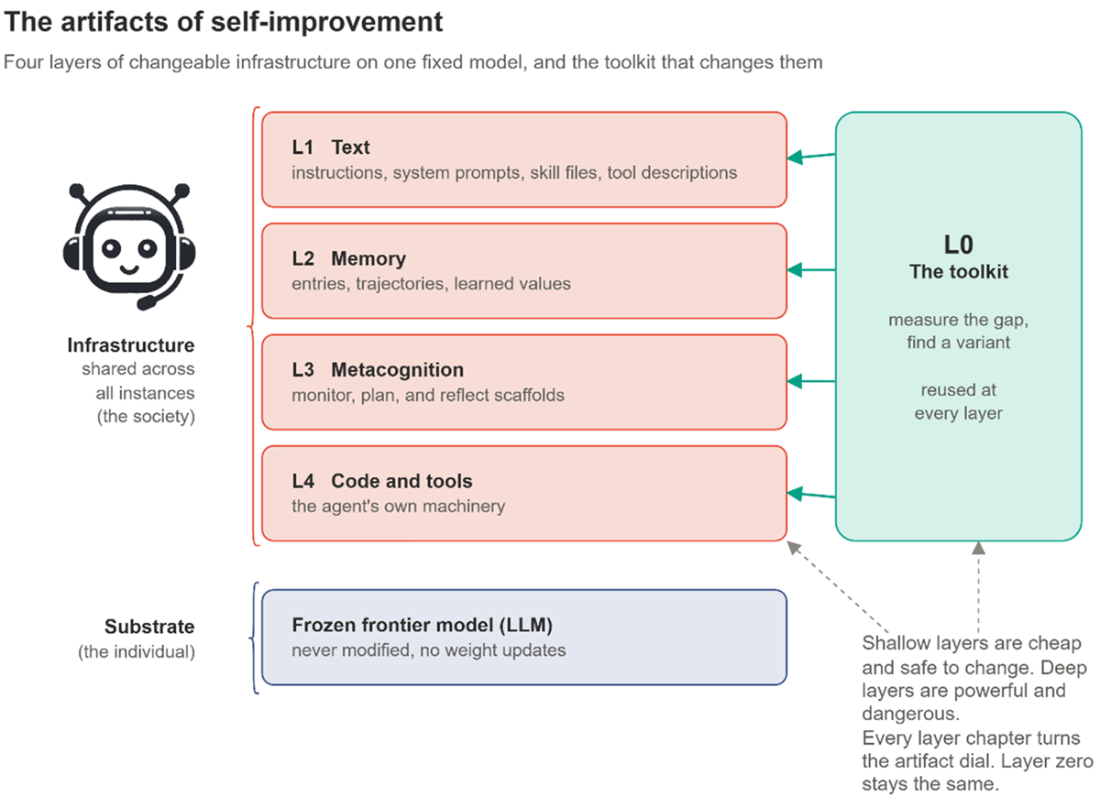
See how L1 sits among shared harness artifact layers beneath a frozen model. section 1.3.2