A text-paired graph associates its nodes, relationships, and graph structures with the documents from which they descend. This preserves links between extracted knowledge and supporting textual evidence. section 13.4.3
A text-paired graph supports retrieval by combining:
- Document metadata such as publication date, type, source, and author, represented as properties or relationships. section 13.4.3
- Structured entity and relationship patterns that select documents mentioning required entities and connect them through graph paths. section 13.4.3
- Traceability from extracted entities and relationships back to original documents, improving grounding and transparency for generated answers. section 13.4.3 section 13.5
Archive retrieval
The Rockefeller Archive Center KG represents documents as nodes with author, type, and date properties, while extracted entities and relationships remain traceable to those documents. A Graph RAG agent can use this structure to select relevant evidence. section 13.4.3
Figure 13.3 The Rockefeller Archive Center KG combines a text-attributed graph and a text-paired graph. Documents are represented as nodes, each with properties representing metadata such as author, type of document, and date. The extracted entities and relationships are traceable back to the original documents, which enables us to design a KG-based document selection tool for AI agents.
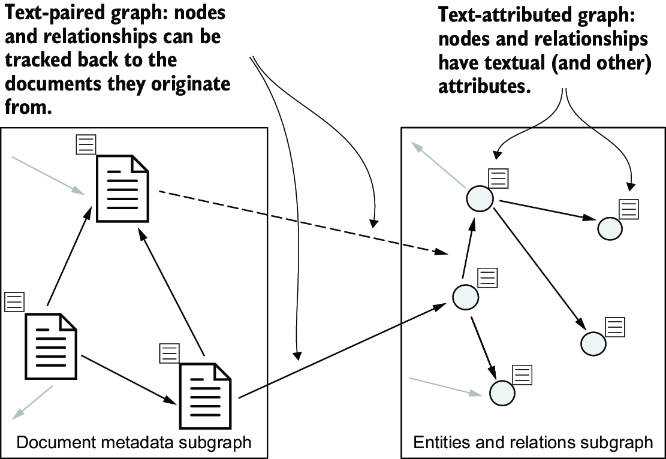
Inspect the architecture linking document nodes, metadata, extracted entities, relationships, and AI-agent document selection. section 13.4.3
