A thermal knee is the point during sustained computation when thermal management sharply reduces performance. It makes cold-start latency a poor proxy for the latency users experience after a device has been working for minutes. section 11.1.2 section 11.0
Mobile SoCs use junction-temperature protection, with a TJMax around 95–105 °C, and a virtual-skin-temperature loop that protects the user's hand. Under tight inference loops, the skin-temperature loop can trigger first and sharply lower clocks, halving throughput within seconds. Whether the knee appears depends on the workload and device; a short benchmark can miss it. section 11.1.2 section 12.2
Measure sustained behavior rather than relying on a cold-start result:
- Run a sustained loop and compare throughput in the last 30 seconds with the first 30 seconds; report the retention percentage alongside the workload and duration. section 11.1.2
- Treat the result as workload-specific. A 300-second M3 vision run lost 35.6% over a 60-second sweep, while Pixel results stayed within 1.3 percentage points of 100% retention. section 11.1.2
- A light M3 vision workload showed 106.47% retention after 300 seconds, partly because Core ML dispatch warm-up slowed the initial window; that result does not rule out throttling under heavier conditions. section 12.2
Figure 11.2 Thermal retention across modalities and devices. Bar height is 100 × last_30s / first_30s of sustained throughput; 100% (dashed line) is the no-throttle baseline. Bar hatches encodes modality (vision plain, audio dotted, LLM cross-hatch). Annotations report retention percentage and first → last absolute throughput in the modality's native unit. The M3 vision 60 s bar loses 35.6%; the M3 audio 300 s bar shows a 54.1% gain; the Pixel bars hold within 1.3 percentage points of 100%.
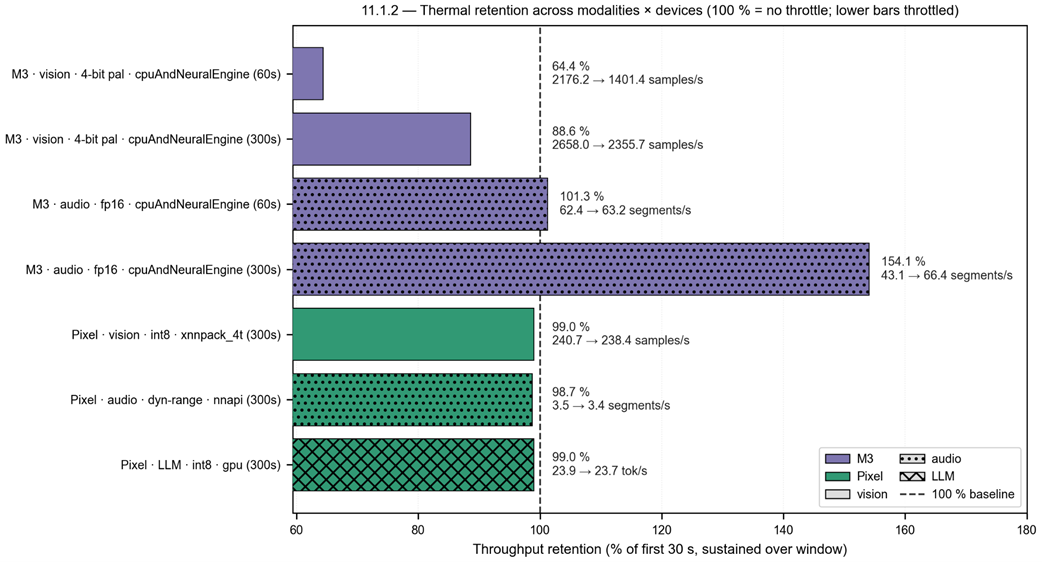
Compare throughput retention across modalities and devices, including the M3 vision drop and Pixel's near-flat results. section 11.1.2
