A customer churn prediction system estimates which customers are likely to end their relationship with a business. For The Bike Shop, it is a proposed system, not an established capability: the first task is to verify that data in the opdis2 warehouse and other assets can support it, then measure prediction performance using recall and precision. Delivery depends on that feasibility work satisfying the customer. section 3.5 section 4.9
Turn the proposal into testable project work:
- Confirm access to opdis2 and other required assets, including whether data can be extracted into an approved development environment. section 3.5
- Check whether data from two to five years ago is good enough for churn modeling; quantify how its quality affects model rank and usefulness. section 4.9
- Evaluate predictions with recall and precision rather than treating a working model as sufficient evidence of success. section 3.5
- Investigate how migrated data and dataflows on a new cloud platform could provide timely, actionable information for customer interaction. section 3.5
Keep delivery assumptions visible. The proposed architecture is not yet known, some customer data is personally identifying, and cloud migration has its own milestones. These are project dependencies to resolve, not details a prediction score can settle. section 3.5
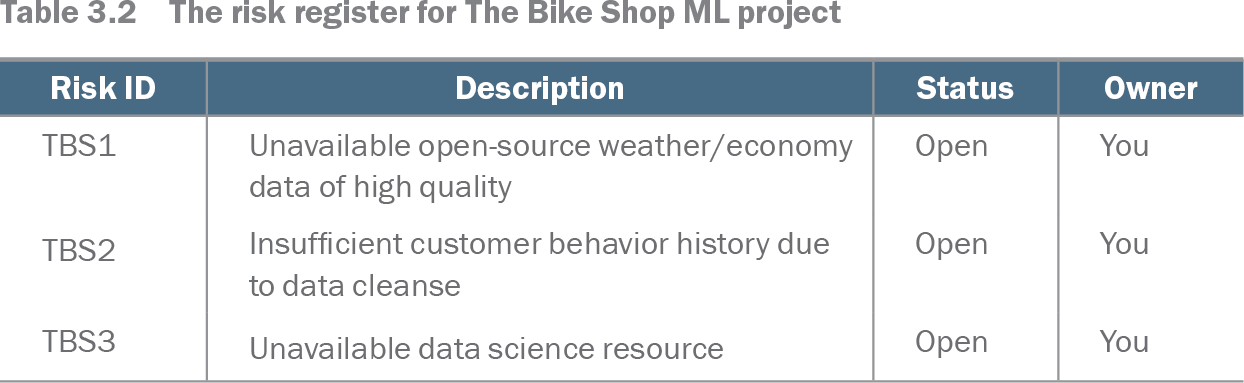
Table 3.2 The risk register for The Bike Shop ML project (view table figure)
| Risk ID |
Description |
Status |
Owner |
|---|---|---|---|
| TBS1 |
Unavailable open-source weather/economy data of high quality |
Open |
You |
| TBS2 |
Insufficient customer behavior history due to data cleanse |
Open |
You |
| TBS3 |
Unavailable data science resource |
Open |
You |
The risk register tracks insufficient customer behavior history after data cleansing, a direct threat to the proposed churn work. section 3.5