A thread block is a group of GPU threads organized to work together. Warps form blocks, and all blocks launched for a kernel form a grid that covers the computation. The GPU schedules blocks across its streaming multiprocessors (SMs), with each SM running one or more blocks at a time as resources permit. section 1.3.3 section 1.5
Figure 1.7 The grid contains every block launched for the kernel, and the GPU schedules those blocks across its Streaming Multiprocessors. Each SM runs one or more blocks at a time depending on available resources and continues pulling new blocks until the grid is fully processed.
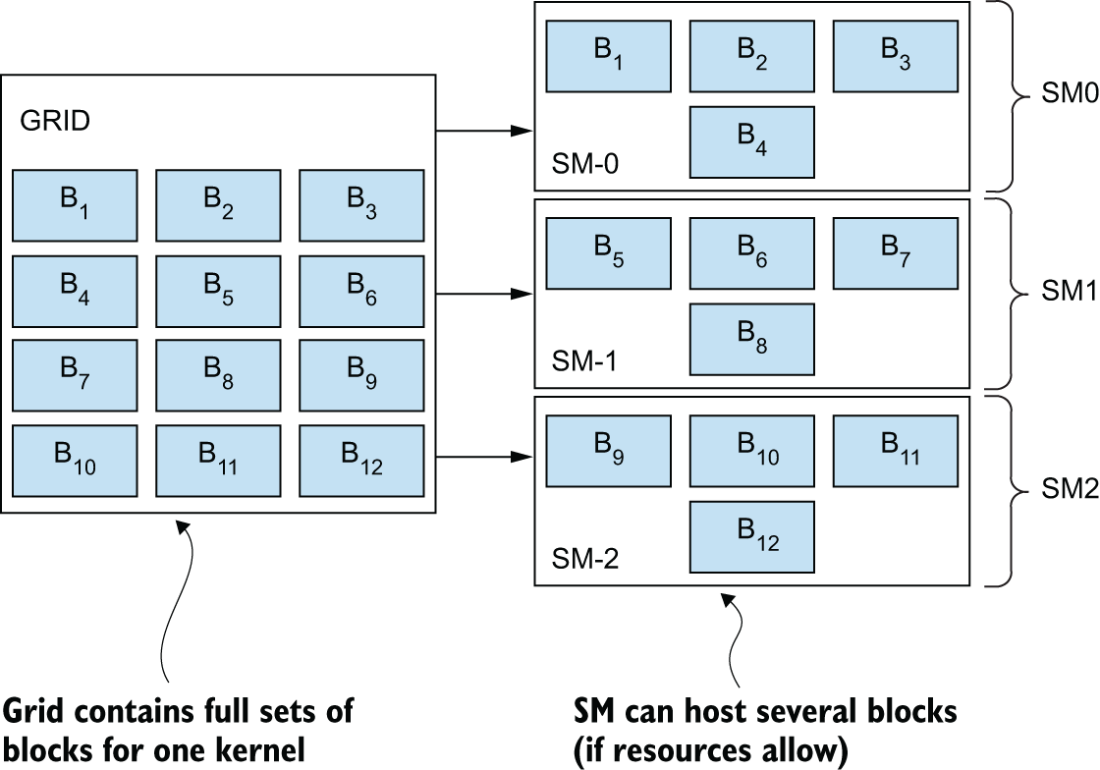
The grid supplies blocks to SMs until all blocks have been processed. section 1.3.3
Threads in a block can cooperate through shared memory: one thread can place data there for another thread in the same block to use. Registers, by contrast, are private to each thread. Shared memory is explicitly managed and is much faster than global memory, though slower than registers. section 1.4 section 1.4
In Triton, a program instance is the unit of work corresponding to a CUDA block. You write the kernel from the perspective of one instance, computing a tile of data and choosing its size; the compiler manages the underlying threads and their coordination. section 1.3.3 section 1.5
Sizing a grid
For a vector of 2,000,000 elements processed at 512 elements per block, the grid needs 3,907 blocks: 3,906 full blocks and one block for the remaining 128 elements. Separately, a 128-thread block contains four 32-thread NVIDIA warps; a grid of 400 such blocks contains 1,600 warps. section 1.6



