A threat feed is a continuously supplied stream of information about cyber threats and indicators. Security teams use it to classify threat vectors, correlate events with known patterns, and support faster, more targeted detection. section 10.3.4 section 10.2.5
Threat feeds support several operational decisions:
- Improve anomaly detection by supplying current threat patterns to machine-learning models. section 10.3.4
- Inform dynamic risk scoring instead of relying only on static assessments. section 10.3.4
- Support predictive analytics by correlating current events with historical attacks and known attack vectors. section 10.2.5
- Help analysts prioritize incidents according to risk, reducing false positives and response delays. section 10.4.3
DataGuard Solutions
DataGuard integrated real-time threat intelligence feeds with an AI-driven anomaly detection system. The system learned to distinguish benign behavior, categorized incidents by risk, and helped the team target a 90% true-positive detection rate and a one-hour average response time. section 10.4.3
Figure 10.2 The left side shows the advanced threat detection metric dashboard for SecureShield before implementing improvements. On the right is the metrics after implementing dynamic risk scoring with anomaly detection and real-time threat intelligence feeds.
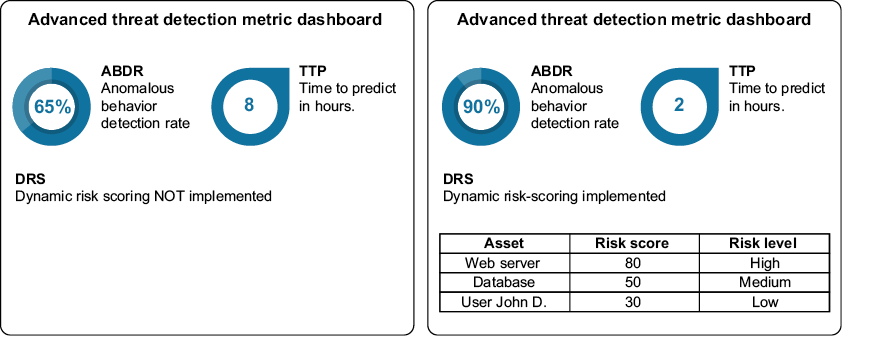
Compare dashboard results before and after dynamic risk scoring, anomaly detection, and real-time threat intelligence feeds. section 10.3.4
Figure 10.3 The left side shows the effectiveness of the AI dashboard, presenting daily false positive rates, true positive detection rates, and the average incident response time. On the right is its effectiveness after implementing an AI-driven solution.
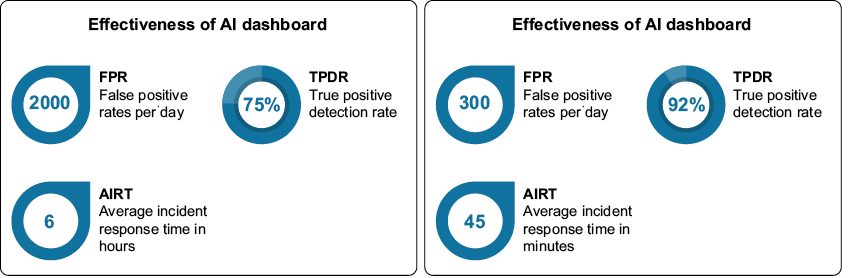
Compare false-positive rates, true-positive detection, and incident response time before and after AI integration. section 10.4.3
