A threat landscape is the set of vulnerabilities, malware, and bad-actor groups affecting an organization. Vulnerabilities create gaps in security controls that attackers can exploit for financial, political, or other malicious purposes. section 1.4
Analyze hostile activity at several levels:
- Identify bad actors, including malicious insiders and external cyber criminals. section 1.4
- Relate each actor’s goal to tactics, techniques, and procedures: a goal is the intended outcome, a tactic is the broad behavior, a technique adds detail, and a procedure provides the most detail. section 1.4
- Study evolving threats and likely compromise paths to strengthen preventive security controls. section 1.4
Treat security improvement as an iterative cycle: investigate incidents, learn from the findings and relevant breaches or security advice, and apply those lessons to future Azure deployments and security practices. section 1.3
The gym analogy
Like someone observing other people at a gym and adapting useful routines, an organization can study how bad actors behave and use those insights to reduce the likelihood of compromise. section 1.4
Figure 1.1 Improving an organization’s security posture can be seen as an ever-evolving and ever-changing cyclical process.
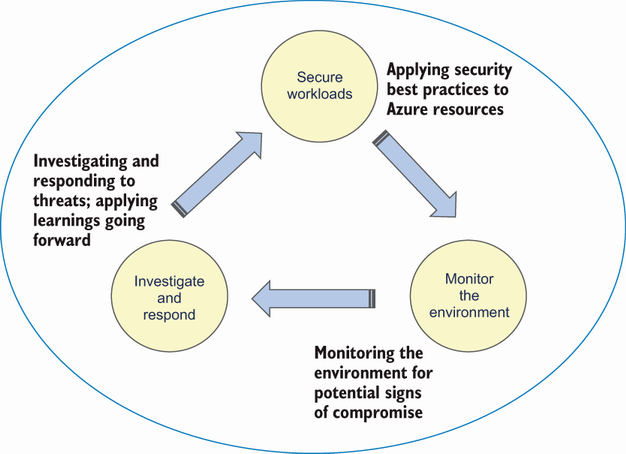
Use the cyclical-process figure to reinforce that improving security posture requires continuous reassessment rather than a one-time control. section 1.3
