liveBook · Manning

Threshold cryptography

As explained in Real-World Cryptography

Threshold encryption is an encryption technique in which participants collaboratively decrypt ciphertext when a required threshold of them participates.

Threshold cryptography decentralizes trust by letting participants jointly perform cryptographic operations without physically holding one complete private key. A required threshold m out of n participants can create a signature or collaboratively decrypt ciphertext, while the scheme tolerates some malicious or inactive participants. section 8.8

The technique connects several familiar building blocks:

  • Distributed key generation creates shared key material and can decentralize Schnorr signatures. section 8.8
  • Threshold signatures let participants produce a verifiable signature using private shares and a previously created public key. section 8.8
  • Secure multi-party computation frames threshold cryptography as a way to compute jointly without relying on a trusted third party. section 15.1
Figure 8.15 A recap of existing techniques to split the trust we have in one participant into several participants.
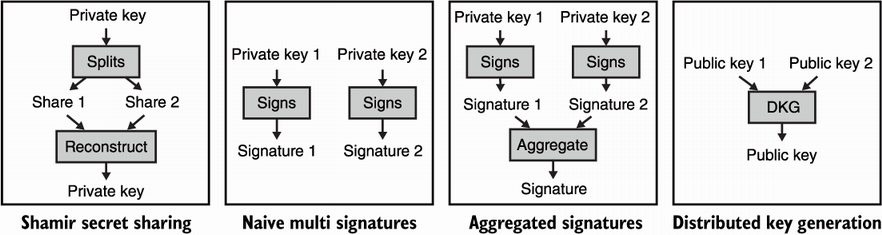
Use the recap to compare techniques that divide trust among multiple participants. section 8.8

How Real-World Cryptography covers it

How deep it goes
Explains threshold participation, distributed signing, key generation, and decryption without giving implementation-level protocol detail.
Examples
Uses collaborative signatures, distributed key generation, and asymmetric decryption as concrete threshold operations.
What it assumes
Builds on familiarity with Schnorr signatures while relating threshold methods to secure multi-party computation.
What you can do after
Understand how to replace single-party trust with collaborative cryptographic operations.
How it connects
Connects Shamir’s Secret Sharing, Schnorr signatures, distributed key generation, threshold signatures, and secure multi-party computation.

Related concepts

This explainer was generated by Manning's knowledge graph from the text of Real-World Cryptography. The section links point to the parts of the book it draws on.