A tile, or block, is a portion of a tensor processed by one Triton program instance. Instead of coordinating individual GPU threads, a kernel operates on the whole tile; the compiler maps those operations to the hardware. A grid launches many instances, allowing independent tiles to be processed in parallel. section 1.1.1 section 2.4
For a one-dimensional workload, each instance uses its program ID to find its block start, then adds local indices to form global offsets. Loads and stores use these offsets to address the elements. If the final tile extends past the input, a mask marks valid positions so invalid loads and stores are skipped. section 2.4
Tiled matrix multiplication
For C = A × B, each program owns a BLOCK_M × BLOCK_N output tile and initializes an accumulator of that shape. It advances through K in BLOCK_K-sized slices, loading a BLOCK_M × BLOCK_K tile of A and a BLOCK_K × BLOCK_N tile of B. Each tl.dot result is added to the accumulator, which is stored after the last slice. Reusing loaded values across output elements raises arithmetic intensity. section 5.5.4 section 5.5.5
Figure 5.12 Tiled matrix multiplication for the 4 × 4 numerical example. Program (0, 0) owns C 00. It multiplies A 00 by B 00 for the first K slice, carries the resulting accumulator into the second slice, and adds A 01B 10 before storing C 00. Programs (0, 1), (1, 0), and (1, 1) perform the same K-loop pattern independently for the other output tiles.
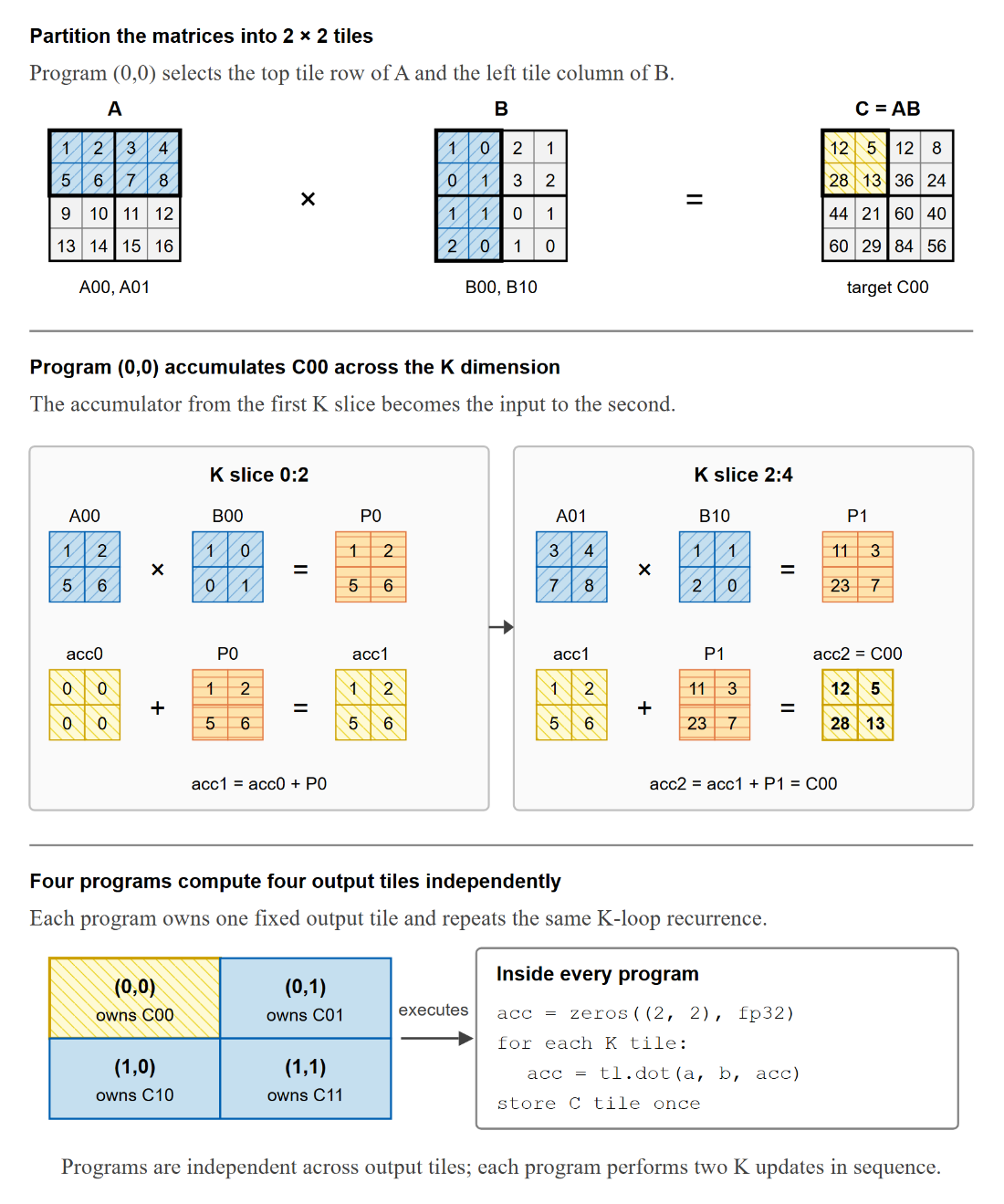
Follow the K-slice updates within one output tile alongside the independent programs computing the other tiles. section 5.5.4
Tile shape affects reuse and performance. Square output tiles balance reuse and minimize the combined size of the input tiles for a fixed number of output elements, though rectangular tiles can be faster for a particular matrix shape or GPU. The first tiled kernel uses an FP32 accumulator to reduce rounding error and assumes dimensions divide evenly by the block sizes; it does not yet handle boundaries or a K remainder. section 5.5.4 section 5.5.5


