A transpose can compute correct output addresses yet perform poorly if neighboring GPU lanes access strided global-memory locations. A tiled transpose reorders values on chip so both the input load and output store can access neighboring addresses together. section 5.10 section 5.4.3
In a low-level shared-memory implementation, threads load a tile in coalesced order, synchronize, then read it transposed and store it in coalesced order. Synchronization ensures every tile value is written and visible before threads begin the transposed read. Triton expresses the operation with whole-tile loads and stores: `tl.make_block_ptr` describes each input and output block, `tl.trans` reorders the loaded tile, and `boundary_check` handles edge tiles. The Triton kernel does not declare a shared-memory array. section 5.4.3 section 5.4.3
Transpose one tile
For a tile at program IDs `(pid_m, pid_n)`, load input offsets `(pid_m * BLOCK_M, pid_n * BLOCK_N)` with block shape `(BLOCK_M, BLOCK_N)`. Store `tl.trans(tile)` at output offsets `(pid_n * BLOCK_N, pid_m * BLOCK_M)` with the block dimensions reversed. Boundary checks protect incomplete tiles. section 5.4.3
Figure 5.9 Shared-memory staging for a tiled transpose. The kernel loads an input row contiguously, changes the traversal direction on chip, and writes the corresponding output row contiguously. The highlighted values show how input column 0 becomes output row 0.
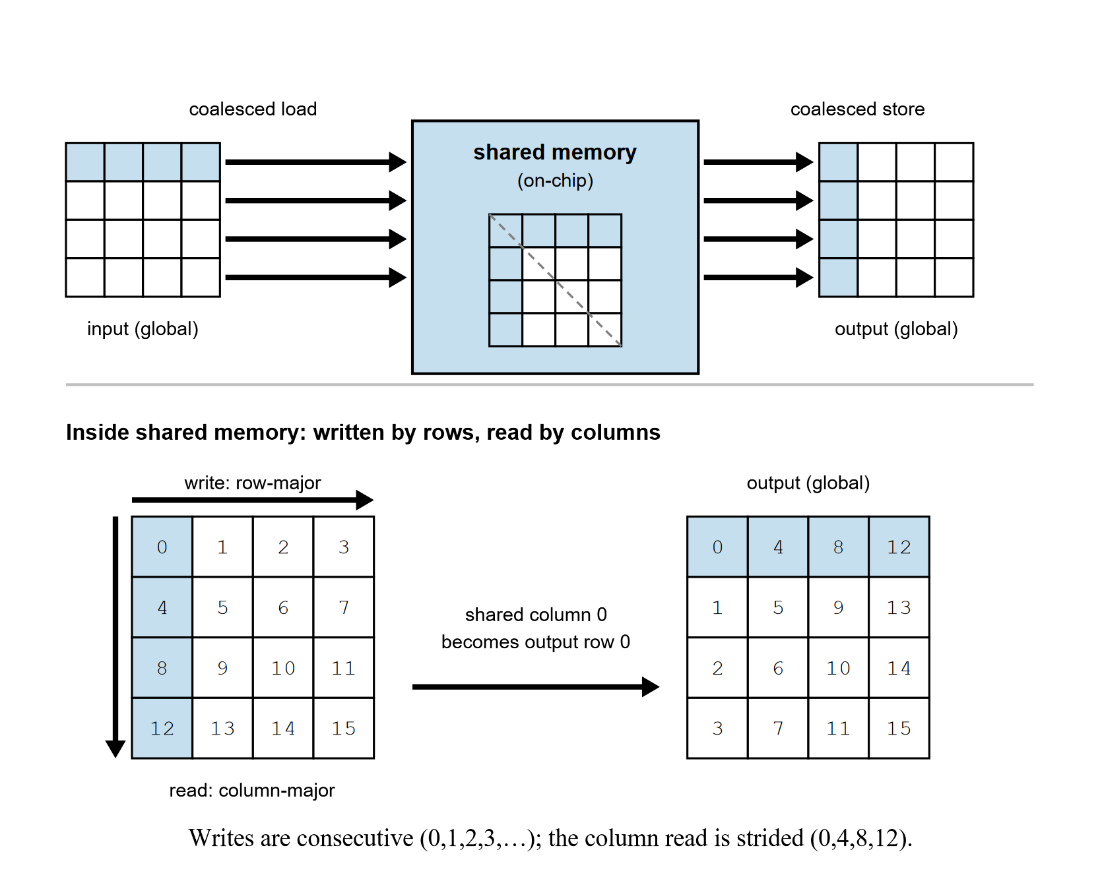
Trace how a contiguous input row is reordered on chip before a contiguous output row is written. section 5.4.3
