Tiling divides a large GPU computation into blocks whose data fits in fast on-chip shared memory. In matrix multiplication, a naïve kernel repeatedly fetches rows and columns from global memory. Loading smaller matrix tiles once and reusing them for multiple calculations reduces redundant transfers and helps keep compute units busy. section 9.4
Tiles work best when threads load nearby addresses together. A GPU warp contains 32 threads; consecutive accesses can be combined into a coalesced memory transaction. Matrix layout therefore matters alongside tile size: a layout that makes the needed elements scattered can waste memory bandwidth or require a transpose. CUDA blocks map naturally to tiles because their threads can cooperate through shared memory. section 9.4
Figure 9.6 Tiled matrix multiplication. Large matrices are divided into tiles that fit into shared memory. Each tile is computed cooperatively, enabling data reuse and coalesced memory access.
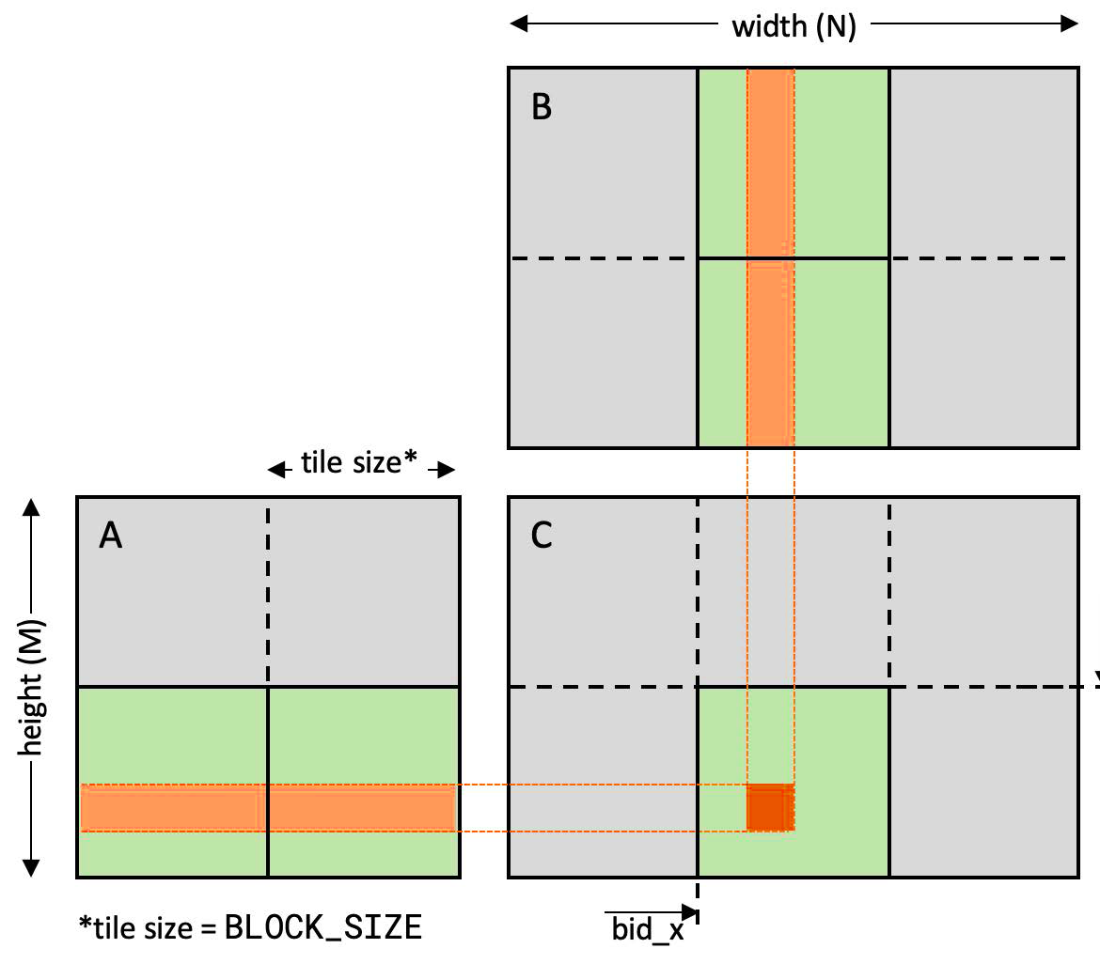
The tiled matrix-multiplication diagram shows how cooperating threads reuse matrix blocks held in shared memory. section 9.4
FlashAttention applies the same locality principle to attention. Standard attention materializes an n × n score matrix; FlashAttention instead streams tiles of queries and keys into on-chip SRAM. It computes partial scores, updates softmax normalization incrementally, and accumulates the result with values. This avoids storing the full intermediate matrix in high-bandwidth memory while preserving exact attention rather than approximating it. section 9.4.1
Figure 9.8 Blockwise computation in FlashAttention. Rather than materializing the full n × n attention matrix, the algorithm streams tiles of Q and K into SRAM, applies softmax locally, rescales for global normalization, and accumulates outputs. This avoids expensive HBM traffic.
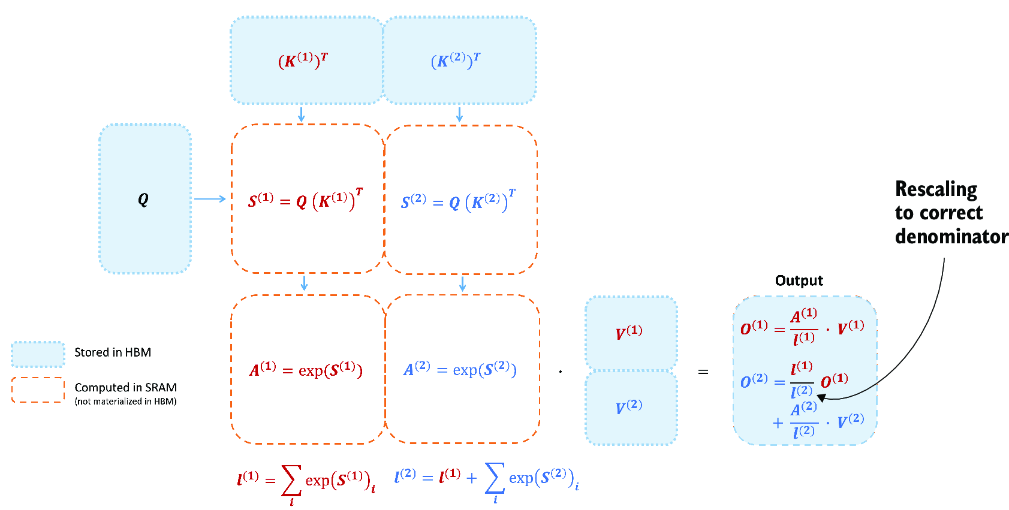
The blockwise attention diagram shows how streamed tiles contribute to globally normalized outputs without materializing the full score matrix. section 9.4.1
Enable a tiled attention implementation
When loading a causal language model with AutoModelForCausalLM.from_pretrained, set attn_implementation="kernels-community/vllm-flash-attn3". This selects FlashAttention-3; it does not require changing the attention formula. FlashAttention-3 targets NVIDIA Hopper features, including hardware-assisted tile transfers and overlapping matrix multiplication with softmax. section 9.4.1
