Time pressure is the delivery force created when a deadline limits which architectural options remain realistic. It turns architecture from a search for an ideal design into a negotiation among time, cost, team capability, risk tolerance, legacy constraints, ownership, and operational needs. A viable design is one the organization can build, operate, maintain, and adapt—not merely approve. section 1.0 section 2.0
A hard deadline should narrow choices deliberately rather than trigger random cutting. Identify what cannot move and why; distinguish essential behavior from cleaner design; protect security, data integrity, deployment, rollback, and critical user paths; then select the simplest safe architecture that meets current intent. The aim is not to eliminate compromise, but to prevent invisible compromise. section 2.1
Make shortcuts governable by recording:
- What was skipped and why it was not necessary for the immediate objective. section 2.1
- What future obligation, operational burden, risk, inflexibility, or loss of clarity the choice creates. section 2.1
- Who owns the consequence and when the decision will be revisited. section 2.1
- Whether the shortcut would immediately make the system difficult to understand, operate, or recover after release. section 2.1
Choosing the smaller safe option
For a one-off change, manual testing may be sufficient when it enables critical functionality to ship on time. Likewise, a synchronous API can be preferable to introducing event-driven architecture when it satisfies the immediate need and substantially reduces delivery time. These are deliberate choices only when their limits and later costs are visible. section 2.1
Figure 2.2 Time-to-market compresses the architectural option space. The less time available, the fewer classes of solutions remain realistic.
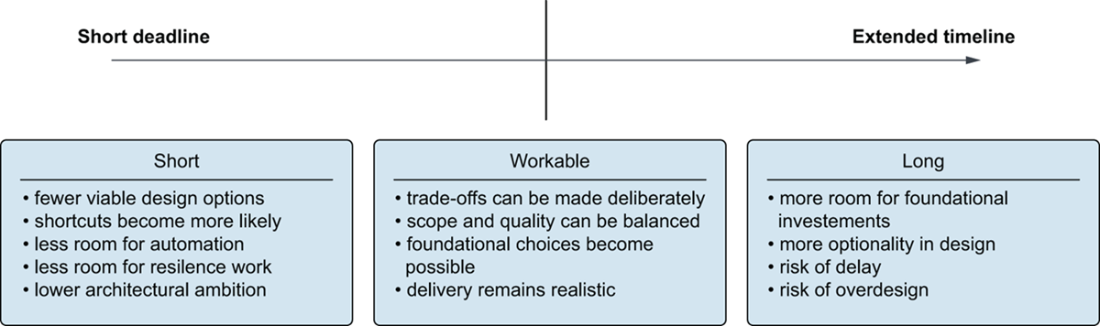
Shows how reduced time-to-market compresses the architectural option space, leaving fewer solution classes realistic. section 2.1
Time pressure does not end at release. Leaders set conditions through delivery expectations, funding, ownership, and capability investment; architects make options, risks, and consequences visible. Production pain, failed assumptions, incidents, and difficult migrations should feed later decisions, helping reduce the cost of mistakes and simplify complexity that no longer earns its keep. section 4.9