A developer may sign up, try an API, and still never use it in production. Time-to-first-call metrics separate those steps. Time to First Call (TTFC), also called Time to First Hello World (TTFHW), measures how long a new user takes to make an initial API call. Time to First Transaction (TTFT) measures how long a user takes to make a first production API call. TTFC is an acquisition metric; TTFT is an activation metric. section 11.1.3
Define the production milestone before reporting TTFT. For some organizations, any production API call counts. Others require a completed business transaction—or several transactions—that represents significant value. A sandbox call may show that a developer can try the API, but it does not establish production use. section 11.1.3
To inspect the journey in Moesif:
- Capture sign-up actions and API-call events with user identities and event times. section 11.1.4
- Inspect the event log and sign-up reports before interpreting a funnel; they show which events arrived and which users signed up. section 11.1.4
- Add a First Production Call step to the user funnel analysis to display TTFT and examine how many users reach that step. section 11.1.4
Product Catalog API simulation
A GitHub Actions workflow simulates developer sign-ups and gateway API calls, sending their events to Moesif. Its roughly 15-minute run produces TTFHW and TTFT values in minutes. Treat those as test data: real journeys may take days, weeks, or months. section 11.1.4
Figure 11.19 Add an additional criteria step, First Production Call, to the User Funnel Analysis report to update it to show the TTFT value.
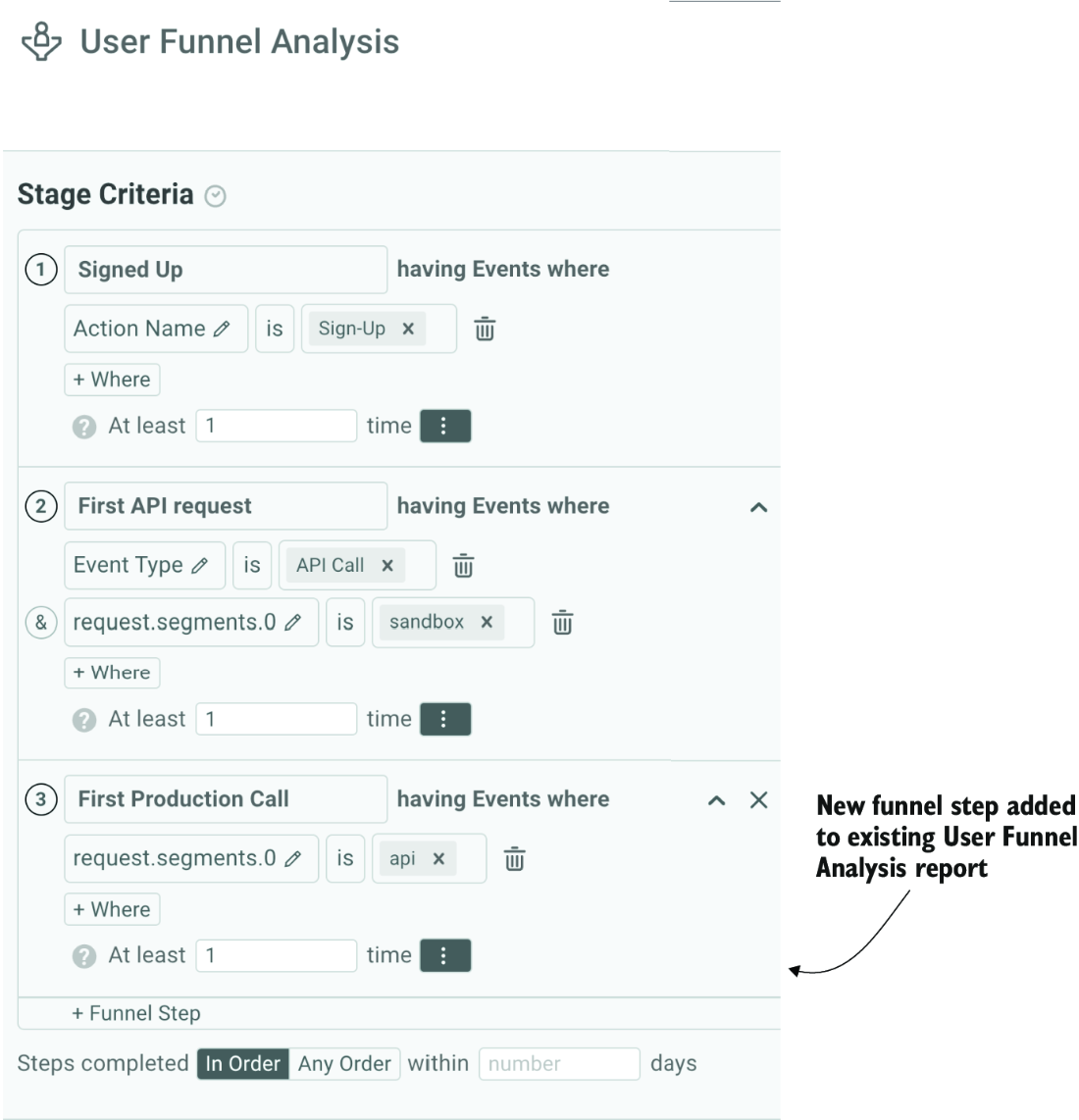
The funnel configuration adds First Production Call as the step used to display TTFT. section 11.1.4
Use TTFT alongside sign-ups, initial-call timing, active users, and conversion rates rather than as a stand-alone verdict. Together, these measures help the API team see where developers progress—or stop—between trying the API and using it in production. section 11.1.3 section 11.4
