Time to predict (TTP) measures the elapsed time between a threatening anomaly becoming detectable and an AI system generating a sufficiently confident prediction to prompt action. Shorter TTP gives security teams more opportunity to prevent escalation. section 10.3.2
Calculate TTP by comparing two operational timestamps:
- Data ingestion start time: when the system begins processing relevant network logs, user behavior patterns, or traffic anomalies. section 10.3.2
- Prediction time: when the system identifies a potential attack with enough confidence to prompt action. section 10.3.2
- Interpret the difference as the window available for preemptive action; a shorter interval indicates faster threat identification. section 10.3.2
TTP supports proactive cybersecurity by using real-time data, historical attack patterns, behavior analysis, and threat intelligence to forecast attacks before critical stages such as ransomware file encryption. section 10.3.2
SecureShield reduces its prediction window
SecureShield initially required an average of 8 hours to predict threats, leaving attackers time to infiltrate systems. After tuning anomaly detection, adding real-time threat intelligence, and adopting adaptive risk scoring, TTP fell to 2 hours, giving analysts more time to respond before escalation. section 10.3.4

Use the figure to follow the interval from incoming security data and detectable anomalies to a prediction that can trigger action. section 10.3.2
Figure 10.2 The left side shows the advanced threat detection metric dashboard for SecureShield before implementing improvements. On the right is the metrics after implementing dynamic risk scoring with anomaly detection and real-time threat intelligence feeds.
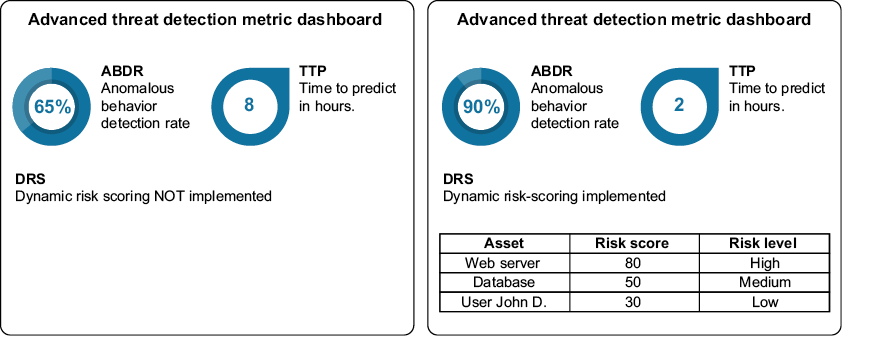
Compare SecureShield’s dashboard before and after anomaly-detection tuning, real-time threat intelligence, and dynamic risk scoring. section 10.3.4
