Time-weighted return measures investment performance while removing the effects of deposits and withdrawals. It links each subperiod return across cash-flow boundaries, making it useful for evaluating a manager when client cash-flow decisions are outside the manager’s control. section 7.1.1 section 7.3
A two-year account with a deposit
An account grows from $10 million to $12 million after a 20% first-year return. The investor then deposits $10 million, and a -10% second-year return reduces the $22 million account to $19.8 million. The time-weighted annualized return is [(1.2)(0.9)]^(1/2) − 1 = 3.92%, even though the investor’s total deposits exceed the ending value. The measure evaluates the 20% and -10% investment results without weighting them by the deposit’s size. section 7.1 section 7.1.1
Compute the measure by linking returns between cash-flow events:
- Divide the investment history into subperiods at each external cash inflow or outflow. section 7.1.1
- Calculate each subperiod return using the market value immediately before the cash flow occurs. section 7.1.1
- Compound the subperiod growth factors and annualize: rTW = [(1+r1)(1+r2)…(1+rn)]^(1/Y) − 1. section 7.1.1
- Treat reinvested dividends and interest as investment returns; treat distributions as withdrawals. section 7.1.1
- For a simpler computational approach, calculate daily returns whether or not cash flows occur. section 7.1.1
Figure 7.1 A simple example of an investment with two deposits
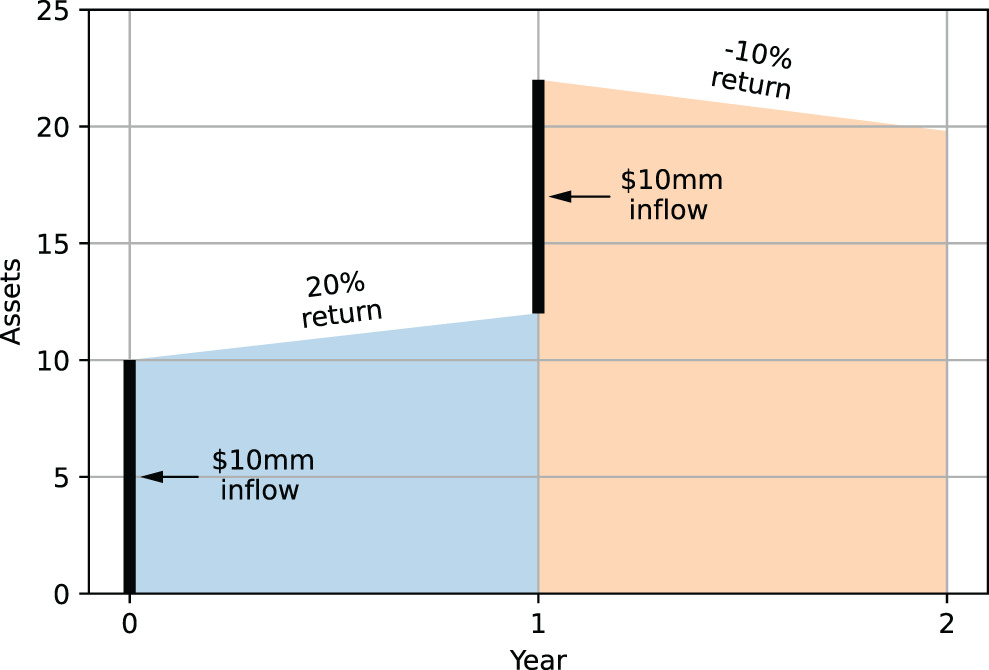
Compare the account’s deposits, intermediate values, and returns visually before applying the time-weighted calculation. section 7.1
