tl.advance returns a new block-pointer descriptor with its offsets changed and its base address, shape, strides, and block shape preserved. Supply one element-offset value per dimension; tuple positions correspond to tensor dimensions. It changes coordinates only—it neither loads data nor checks bounds. section 5.6.3
Advance through the shared K dimension
In tiled matrix multiplication, advance A by (0, BLOCK_K) across its columns and B by (BLOCK_K, 0) down its rows. The descriptors then select matching K slices for the next loads and tl.dot. Reassign each returned descriptor to continue the loop; a negative offset can move a descriptor backward. section 5.6.3
Figure 5.14 Block-pointer movement through the K loop. The A descriptor advances by (0, BLOCK_K) across columns, while the B descriptor advances by (BLOCK_K, 0) down rows. Each pair of descriptors selects matching K slices for the next load and tl.dot call.
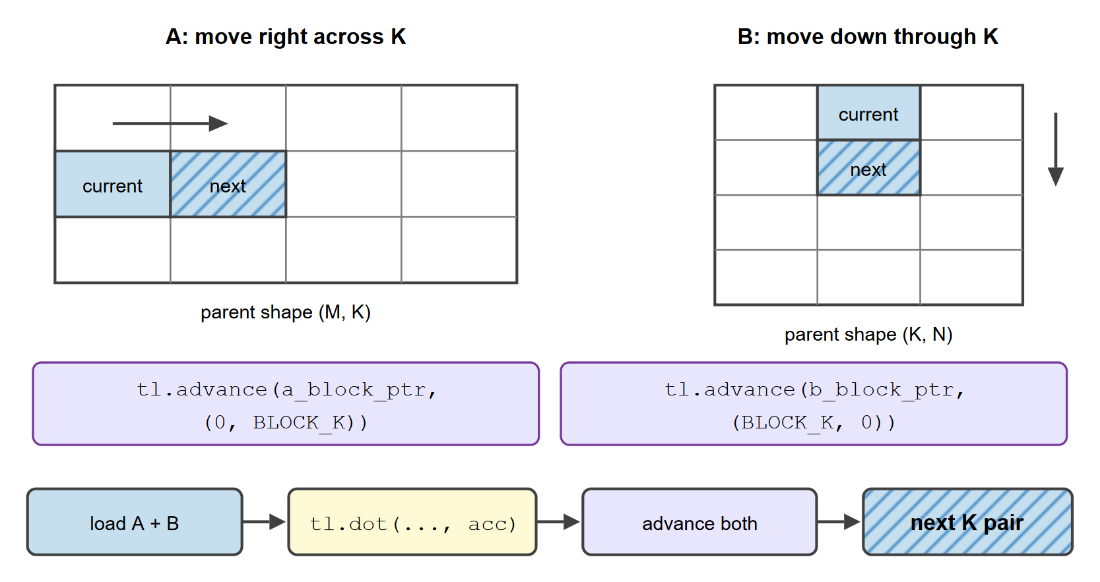
The diagram shows how the two descriptors move to matching slices between K-loop iterations. section 5.6.3
