liveBook · Manning

Token tampering attack

As explained in Secure APIs

A token tampering attack modifies a security token so that its claims or validation behavior grant unauthorized access.

A token tampering attack changes an API access token so flawed validation grants access the attacker should not have. JWTs carry user information and use signatures to protect integrity; accepting an improperly validated token can enable account hijacking and privilege escalation. section 4.4

Check the credential-validation process for these failure modes:

  • Failing to validate a token signature correctly allows attackers to tamper with its contents. section 4.4
  • Failing to reject expired tokens allows credentials to remain usable beyond their intended lifetime. section 4.4
  • Distinguish tampering from credential replay: replay uses an intercepted, otherwise valid access token to impersonate its owner. section 4.4
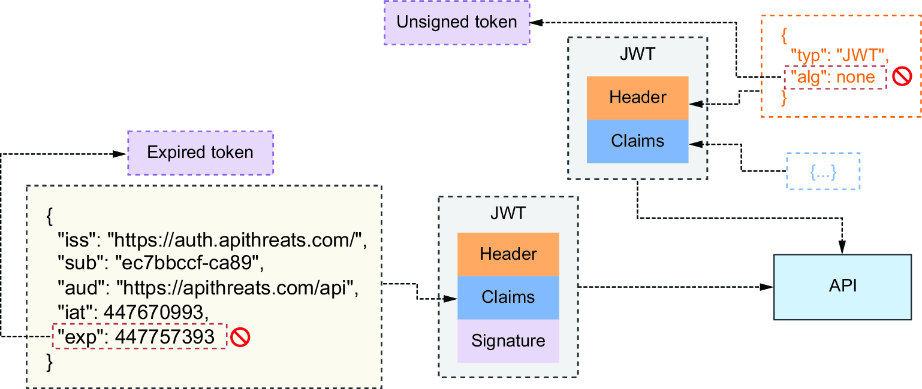
Figure 4.5 A common broken authentication vulnerability is accepting unsigned or expired tokens.
figure

Use the figure to inspect the central failure pattern: accepting unsigned or expired tokens. section 4.4

How Secure APIs covers it

How deep it goes
Identifies signature and expiration failures and their consequences, but does not detail implementation fixes.
Examples
Uses unsigned or expired JWTs as concrete validation-failure examples.
What it assumes
Assumes familiarity with API access tokens and introduces JWTs as signed JSON objects carrying user information.
What you can do after
Diagnose token-validation weaknesses involving signatures, expiration, and replay.
How it connects
Connects JWT, authentication, authorization, privilege escalation, and credential replay.

This explainer was generated by Manning's knowledge graph from the text of Secure APIs. The section links point to the parts of the book it draws on.