An allowlist limits an agent to explicitly approved entities, integrations, commands, or actions. Curating a small set of relevant tools reduces context noise and token cost, while documenting approval makes the boundary reviewable. section 3.3.5
Use an allowlist as an operational control, not as a substitute for enforcement:
- Maintain a team-approved list of enabled servers or tools, document why each is enabled, and review it during onboarding. section 3.3.5
- Prefer a surgically curated toolset over exposing every connected tool; unused definitions consume tokens and compete for attention. section 3.3.5
- Treat instructions and tool annotations as advisory unless external controls enforce them through hooks, CI gates, or sandboxes. section 3.3.5 section 5.5.1
From convention to enforcement
A policy can forbid agents from reading .env files, restrict commands to an approved set, and limit access to selected directories. An instruction file may describe these rules, but pre-commit hooks, CI validation, or a sandbox must reject violations. section 5.5.1
Figure 3.5 MCP Governance layers - the agent communicates through an MCP Gateway (enforcing auth and policies), which routes to an MCP Proxy (aggregating multiple servers into a curated toolset), which connects to individual MCP servers registered in a central catalog. Each layer adds security and reduces context noise.
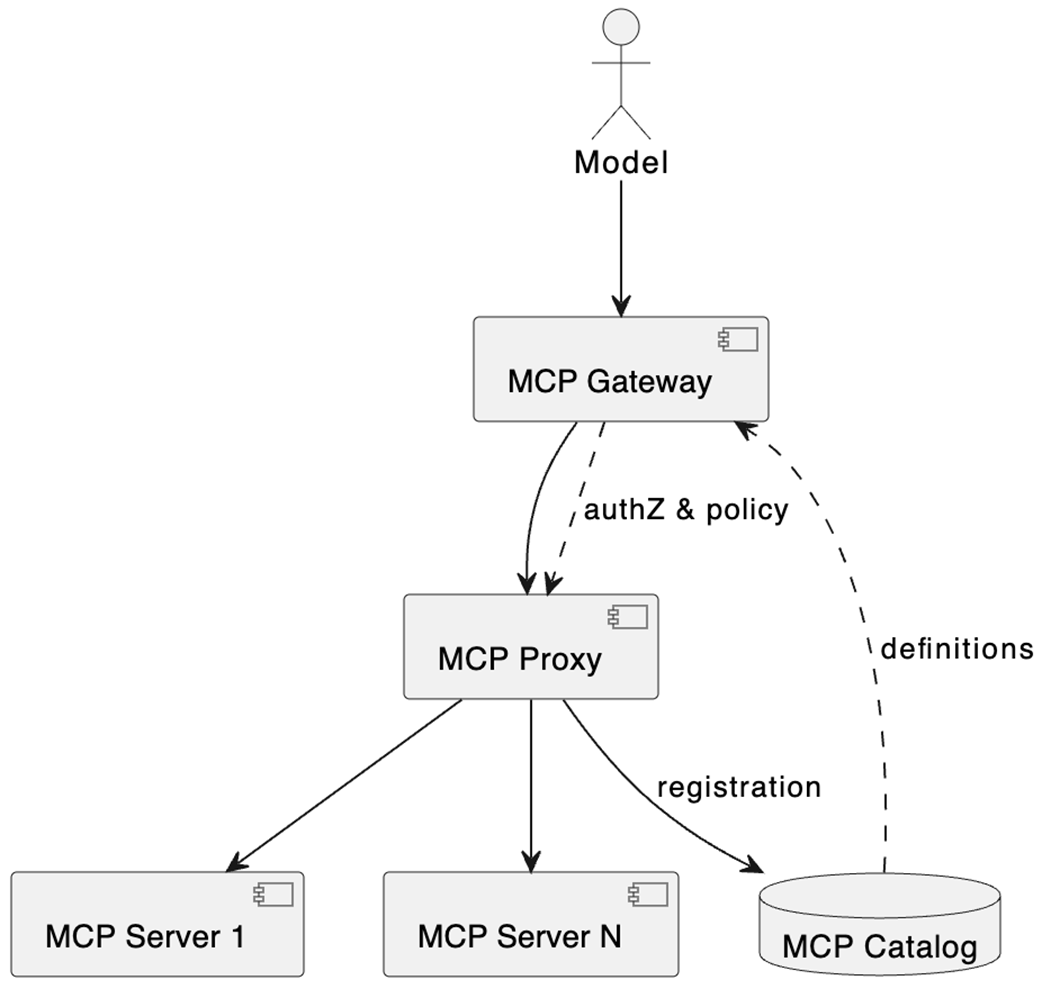
Use the governance-layer diagram to distinguish curated tool exposure from gateway authorization, proxy aggregation, and server registration. section 3.3.5


