Tool explosion occurs when agents see too many available tools, enlarging context, complicating selection, and increasing confusion. It also expands attack surface and can produce inconsistent behavior when teams configure environments independently. section 3.3.5
Use disciplined exposure rather than maximizing availability:
- Keep a team-approved allowlist, document why each server is enabled, and review configuration during onboarding. section 3.3.5
- Prefer two or three well-chosen integrations over twenty poorly configured ones. section 3.3.5
- Use proxies to load relevant capabilities on demand and gateways to enforce authentication, access policies, logging, and real-time blocking. section 3.3.5
Curated task context
A large production deployment may catalog hundreds of MCP tools while handing each task roughly fifteen, with context prefetched so the agent rarely explores or iterates. section 3.3.5
Figure 3.5 MCP Governance layers - the agent communicates through an MCP Gateway (enforcing auth and policies), which routes to an MCP Proxy (aggregating multiple servers into a curated toolset), which connects to individual MCP servers registered in a central catalog. Each layer adds security and reduces context noise.
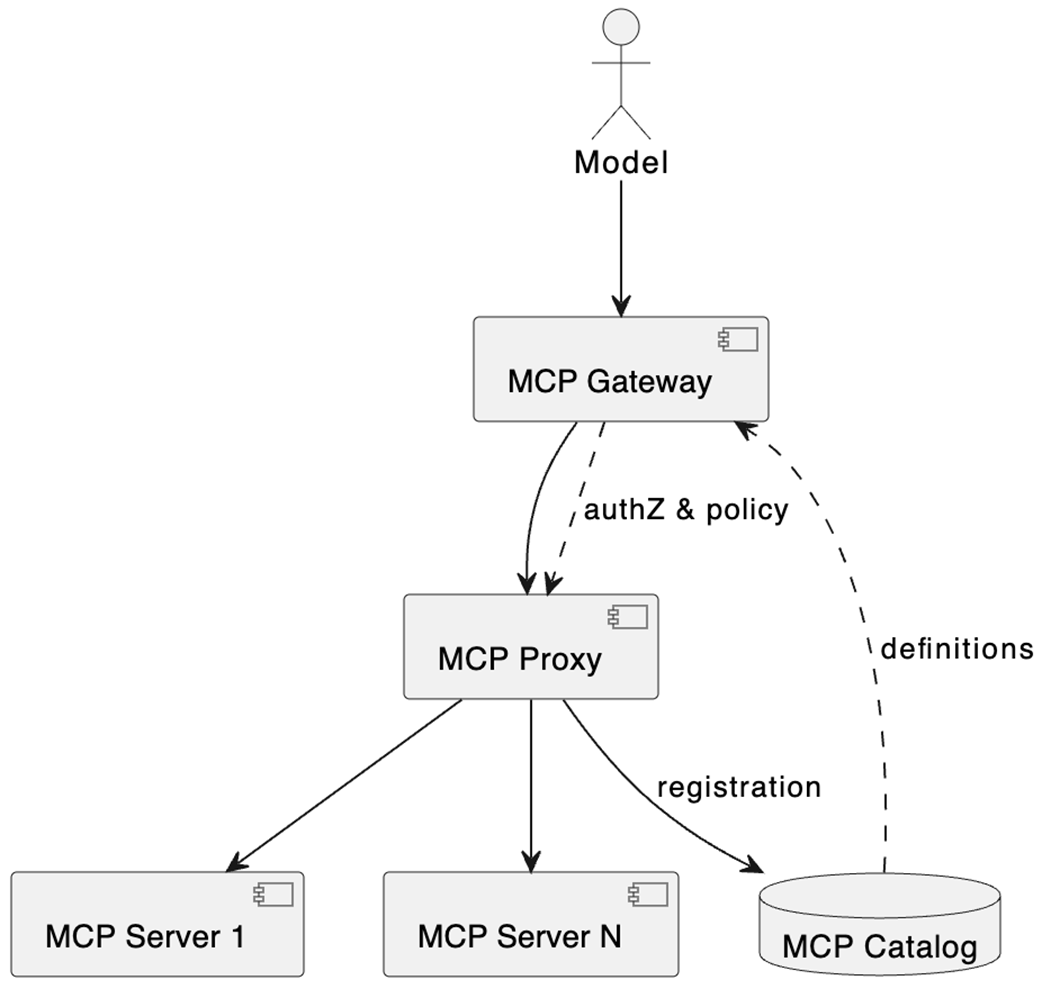
The governance-layer diagram shows how gateways, proxies, catalogs, and MCP servers reduce context noise while adding security controls. section 3.3.5
