A topic space is a reduced vector space whose coordinates represent latent topics rather than individual terms. It gives each document a compact topic-based representation. section 4.6.2
Latent semantic analysis selects the strongest topic dimensions from the eigenvalues of XᵀX, discards weaker dimensions, and retains the corresponding columns of V. If t topics remain, V is m × t; projecting the original document-term matrix X into V produces an m × t document-topic matrix. section 4.6.2
Cosine similarity between rows in topic space can reveal indirect document connections that are hidden when similarity is computed directly from the original term vectors. section 4.6.2
Figure 4.6 Document vectors from our toy dataset d0, ⋯ d6. Each word in the vocabulary corresponds to a separate dimension. Dots show projections of document feature vectors on the plane formed by the axes corresponding to the terms gun(s) and violence.
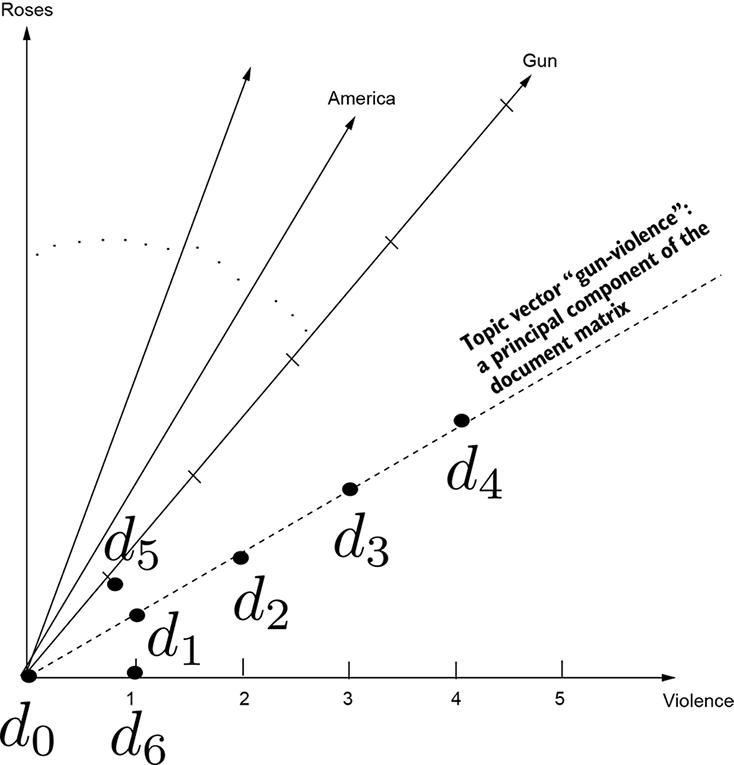
Visualize document vectors as points in a term-coordinate space before dimensionality reduction, then interpret topic space as a lower-dimensional representation. section 4.6.2
