liveBook · Manning

Training regime

As explained in Sutskever's List

A range of training conditions in which a model's scaling behavior follows a relatively consistent pattern.

Scaling laws describe how training loss changes as parameters, data, and compute increase—but only within a particular training regime. A run can leave that regime when it runs out of data or its tokenizer, optimizer, or governing rule changes. section 6.2.1

On a log–log plot, these changes appear as joined straight-line segments rather than one universal line. Loss can remain smooth within a segment even as benchmark results jump: threshold-based evaluations may turn small improvements into many newly correct answers. section 6.2.1

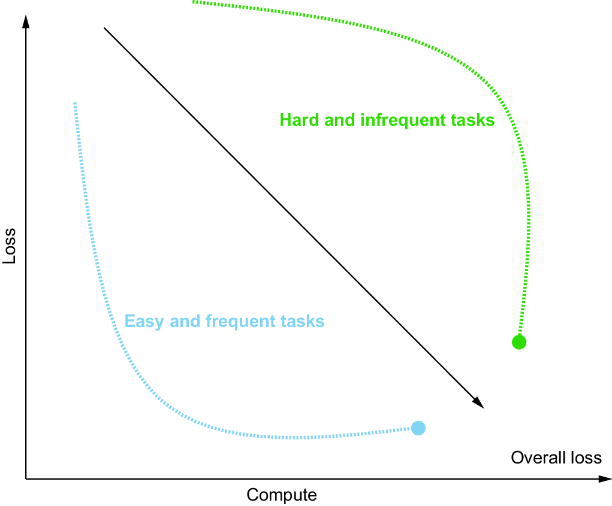
Figure 6.4 A model will learn some tasks more easily than others. Easy tasks are frequent with dense data, while hard tasks are infrequent with sparse data.
figure

Contrasts frequent, data-dense tasks with infrequent, data-sparse tasks, which models learn with different ease. section 6.2.1

How Sutskever's List covers it

How deep it goes
Explains piecewise scaling behavior and thresholded evaluation effects without deriving quantitative laws.
Examples
Names data exhaustion and tokenizer or optimizer changes, and contrasts smooth loss curves with stepped benchmark performance.
What you can do after
Evaluate regime boundaries by comparing smooth training curves with capability-focused evaluations.
How it connects
Connects scaling laws to training loss, compute, data, tokenizers, optimizers, and model evaluations.

This explainer was generated by Manning's knowledge graph from the text of Sutskever's List. The section links point to the parts of the book it draws on.