Transaction ID (XID) wraparound is a PostgreSQL failure mode caused by treating 32-bit transaction IDs as an endlessly increasing sequence. XIDs occupy a circular space of about 4.3 billion values: from any current transaction, roughly 2.15 billion IDs are in the past and roughly 2.15 billion are in the future. A tuple whose XID is too far in the past can appear to belong to the future, making its visibility impossible to determine safely and risking data inconsistency or loss. section 6.6.1
Figure 6.3 Depiction of PostgreSQL’s transaction IDs as a circular space
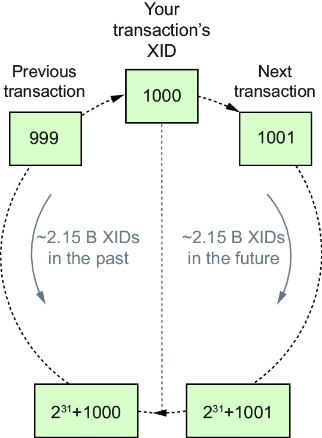
View XIDs as a circle rather than a line: advancing the current ID moves the boundary between past and future. section 6.6.1
PostgreSQL avoids this condition through freezing. VACUUM marks definitively old tuples as frozen, so their xmin is safely outside the active XID space. If freezing falls behind, PostgreSQL starts a noninterruptible anti-wraparound autovacuum. That emergency work is unavoidable once begun and can slow the system to a crawl. section 6.6.1 section 6.7
High transaction burn rate
A write-heavy OLTP system can consume 2 billion transactions quickly; one observed database did so in a week. Treating every incoming operation as a separate commit may let XID consumption outrun autovacuum. If atomicity permits, batching 1,000 commits reduces the XID burn rate to about one-thousandth of the prior rate. Reorganizing incoming rows, summarizing high-volume data, and excluding data unlikely to be used also reduce pressure. section 6.6.2
Keep anti-wraparound work from becoming an emergency:
- Keep autovacuum enabled and effective; it freezes old rows as well as controlling bloat and maintaining planner statistics. section 6.7
- Tune autovacuum to work more aggressively when transaction volume demands faster freezing. section 6.6.2
- Avoid long idle-in-transaction sessions that can block vacuum; use idle_in_transaction_session_timeout only with a timeout the application can tolerate. section 6.5.1 section 6.5.1
- Check the current transaction ID with SELECT txid_current(); when assessing XID progression. section 6.6.1
Do not disable autovacuum for a short-term performance gain. Even when disabled by configuration, PostgreSQL watches for XID exhaustion and can intervene; meanwhile, deferred cleanup accumulates bloat and makes later maintenance more costly. Automatic maintenance is safer than relying on manual intervention. section 6.7 section 6.13
