A money transfer moves a specified amount from a source account to a destination account. A transfer may happen immediately, on a future date, or repeatedly. section 9.4.4
A user-friendly transfer operation requires source, destination, and amount. Currency can default to the source account currency; a date implies a delayed transfer, while frequency implies a recurring transfer. section 9.4.4 section 9.4.1
A practical transfer flow validates both the participants and the transaction:
- List the user’s accounts and exclude blocked source accounts. section 10.3.1
- List preregistered beneficiaries and user-owned destination accounts. section 10.3.1
- Submit the selected source, destination, and amount through the Transfer operation. section 10.3.1
- Handle ownership, account status, authorization, balance, account limits, and rolling user limits before completing the transfer. section 10.3.1
Minimal transfer request
POST /transfers with a request body containing source, destination, and amount represents an immediate transfer. Adding a date schedules it; adding frequency makes it recurring. Omitting currency uses the source account currency by default. section 9.4.4 section 9.4.1
Figure 9.7 We minimize money transfer inputs by determining data based on other data and using default data.
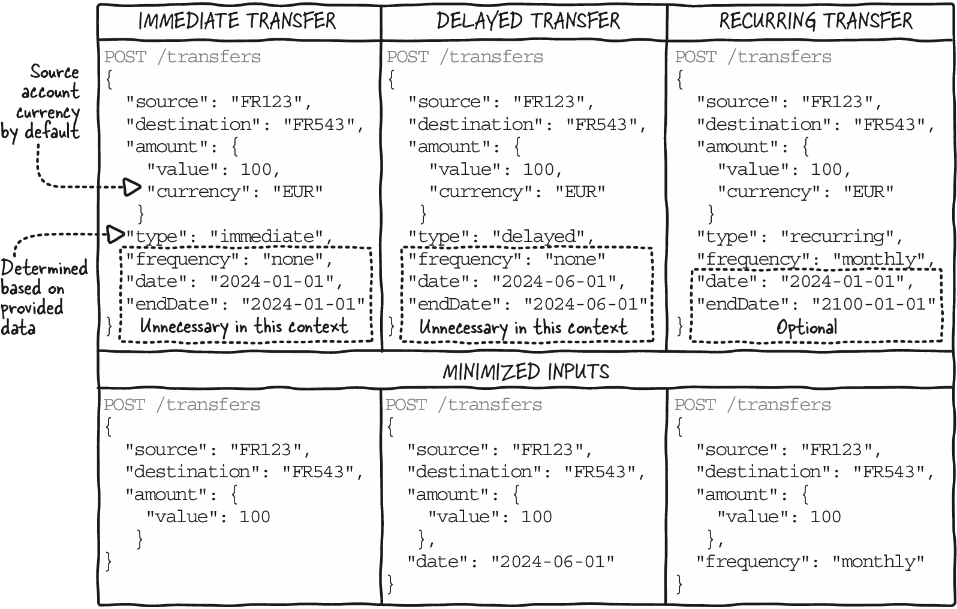
Use the input diagram to compare explicitly supplied transfer data with values inferred or defaulted by the implementation. section 9.4.4
