A geometric transformation maps points in a geometric space to points in that same space. Applied to every point of an object, it describes a change to the object by describing how the surrounding space changes. Translation, rotation, scaling, shear, and projection are useful special cases. section 4.1 section 4.0
Think of a transformation as a point-moving rule rather than a property of one shape. The rule may be written as coordinate functions, vector equations, or matrices; the representation should suit the task. In homogeneous coordinates, a projective transformation can express translation, rotation, scale, and shear as matrix multiplication. section 4.1 section 4.3.3
Matrix-based transformations are particularly practical because they can:
- Compose a sequence of changes into one matrix; associativity also permits parallel composition. section 4.3.3
- Represent an identity transformation and an inverse that undoes a transformation. section 4.3.3
- Avoid unnecessary framework overhead when direct mathematical implementation is appropriate. section 1.3
Page projection and unbending
A flat photographed page can be projected by transforming one quadrilateral into another. A bent page needs a nonlinear transformation instead: cubic interpolation along the bent x direction and linear interpolation along the straight y direction map a standard square onto the photographed page. Composing that mapping with a page-to-square mapping determines pixel colors for an unbent result. section 1.3 section 8.1.3
Transformations also provide a direct way to think about surfaces. A 3D function maps each point of space to another point; restricting it to a plane turns that plane into a surface. Parameterizing the input plane with u and v yields a surface function f(u, v) → (x, y, z), suitable for deformative modeling and interpolation. section 8.2.1 section 8.6
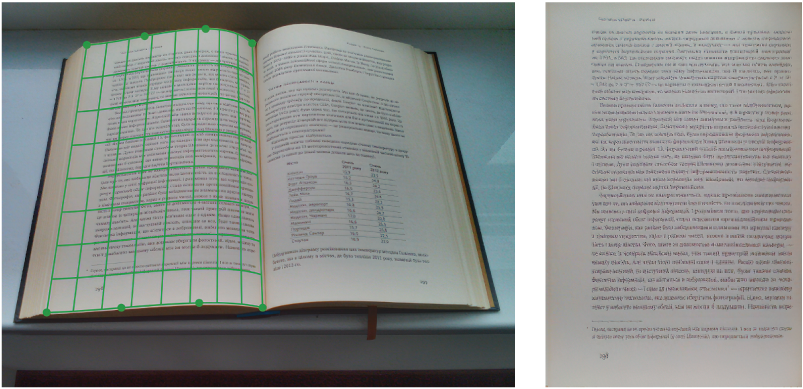
Compare a photographed curved page with its unbent result to see why a projective mapping alone cannot model page curvature. section 8.1.3

