liveBook · Manning

Transistor density

As explained in Fast Python: High performance techniques for large datasets

Transistor density is the number of transistors integrated per unit area of a semiconductor device.

Transistor density measures how many transistors fit on a microchip. Moore’s law describes this density doubling about every two years—not processor speed doubling. That distinction matters: increased density no longer translates linearly into faster sequential computation. section 1.1 section 1.2.1

Figure 1.1 The ratio between Moore’s law and Edholm’s law suggests that hardware will always lag behind the amount of data being generated. Moreover, the gap will increase over time.
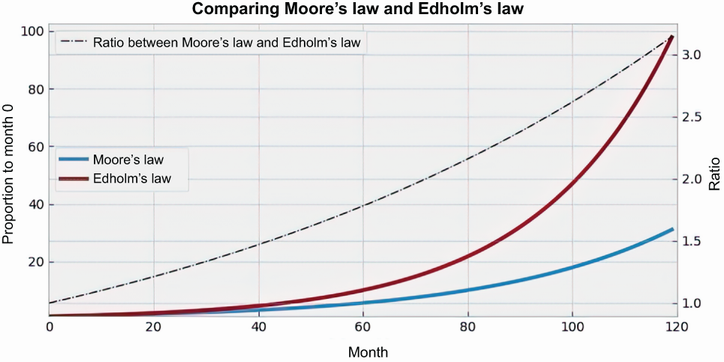
Compare transistor-density growth with data-transfer growth to see how hardware capacity can lag behind the data needing analysis. section 1.1

How Fast Python: High performance techniques for large datasets covers it

How deep it goes
Defines Moore’s-law doubling as transistor density increasing every two years and distinguishes it from speed doubling.
Examples
Plots Moore’s-law transistor-density growth against Edholm’s-law data-rate growth.
What you can do after
Understand why increasing transistor density no longer implies faster sequential computation.
How it connects
Connects Moore’s law and Edholm’s law to contrast hardware growth with data-transfer growth.

This explainer was generated by Manning's knowledge graph from the text of Fast Python: High performance techniques for large datasets. The section links point to the parts of the book it draws on.