A transit network centralizes and coordinates connectivity among networks, regions, accounts, cloud providers, and private data centers. Treating connectivity as a dedicated domain reduces conflicts between traffic modes and enables low-friction expansion. section 7.2
A practical transit network supports:
- Traffic between the public internet, services and databases, availability zones, global regions, cloud providers, and private environments. section 7.2
- Separate production and nonproduction transit gateways in a dedicated account, with local gateways added as accounts and regions expand. section 7.2
- Self-service network connections, using automatic acceptance or an approval function that checks a ticketing system before accepting pending connections. section 7.2
- Policy-based multi-account and multi-region management through AWS CloudWAN, while retaining VPCs for EKS clusters and service connectivity. section 7.2
Expanding an account fleet
A newly provisioned account receives regional local transit gateways and configuration that automatically accepts its networks into the shared transit structure. Teams manage their own account networks without separately handling approval requests. section 7.2
Figure 7.5 This VPC structure creates a solid foundation for most starting EKS implementations.
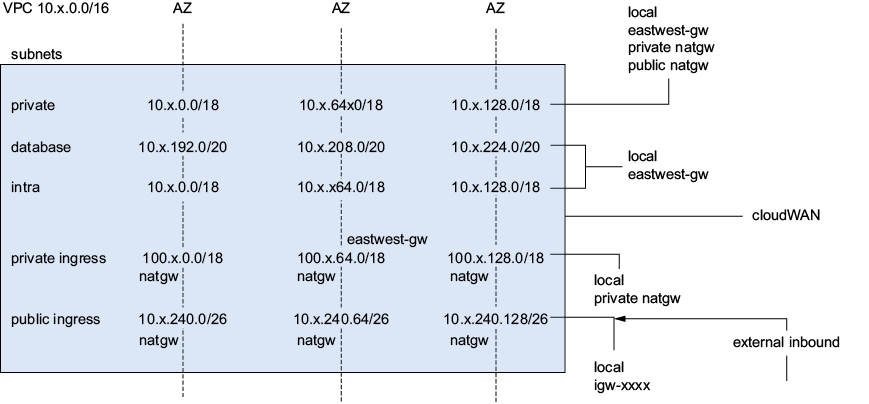
Inspect the VPC structure used as a foundation for starting EKS implementations within a transit-network design. section 7.2
