liveBook · Manning

Transitive dependency

As explained in Microservices Patterns, Second Edition

A dependency introduced indirectly through another dependency rather than declared directly by the application.

A transitive dependency is introduced through another dependency rather than declared directly. It can make a technology stack harder to assemble because the versions of indirectly required technologies must also be compatible. section 5.3.1

Gradle build impact

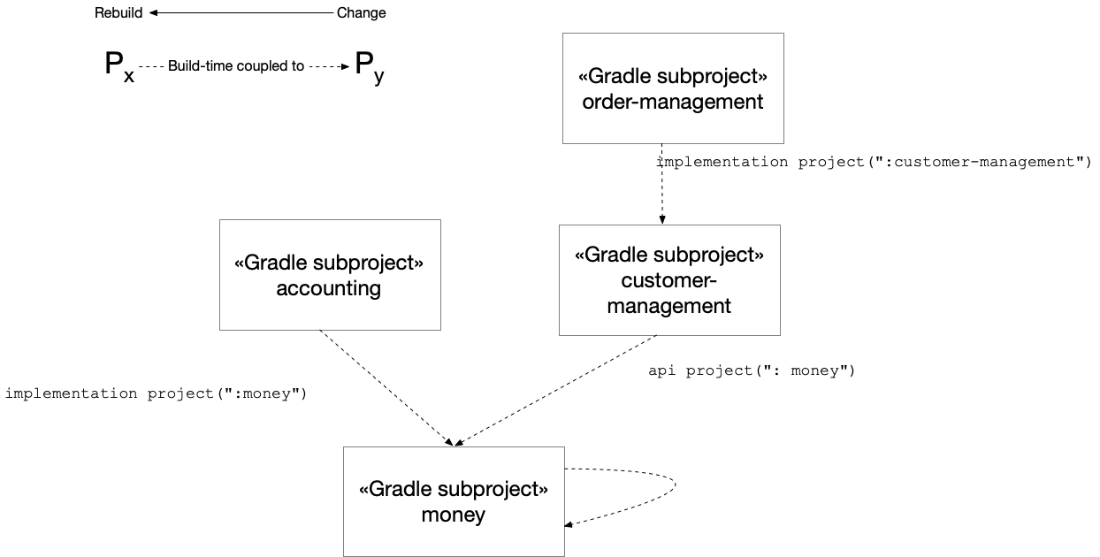
If order-management depends on customer-management, which exposes money through an API dependency, order-management has a transitive dependency on money. Changing money triggers tests in order-management; changing customer-management triggers tests there and in order-management. section 4.3.1

Figure 4.9 The dependencies between Gradle projects create build-time coupling. Changing money causes the other projects to be recompiled and retested but changing customer-management only requires customer-management and order-management to be recompiled and retested.
gradle build time coupling

The dependency diagram shows how changes in one Gradle project can affect downstream projects. section 4.3.1


How Microservices Patterns, Second Edition covers it

How deep it goes
Traces an indirect Gradle dependency into downstream tests and discusses version compatibility, without prescribing resolution steps.
Examples
Uses Java and Maven version conflicts, a Terraform provider blocking a Kubernetes upgrade, and Gradle project dependencies.
What you can do after
Diagnose build impact by tracing an indirect Gradle project dependency to downstream recompilation and tests.
How it connects
Connects transitive dependencies to technology stacks, version compatibility, and build-time coupling.

Also explained in

Compare how 3 books explain transitive dependency →

Related concepts

This explainer was generated by Manning's knowledge graph from the text of Microservices Patterns, Second Edition. The section links point to the parts of the book it draws on.
