liveBook · Manning

Transport layer

As explained in Rust Servers, Services, and Apps

The transport layer provides communication between endpoints and transfers application data as a stream or sequence of transport-level units.

The transport layer provides reliable end-to-end communication between processes by sending and receiving raw bytes. It sits between application protocols such as HTTP and lower networking layers in the TCP/IP model. section 2.1

TCP is the transport-layer protocol used for the server and client implementation. It exchanges data as a continuous stream of bytes, without interpreting application message semantics such as HTTP requests. section 2.4

Basic TCP server and client

A Rust standard-library server and client exchange bytes over TCP. HTTP can operate above that connection, but message parsing and response construction belong to the application layer. section 2.4
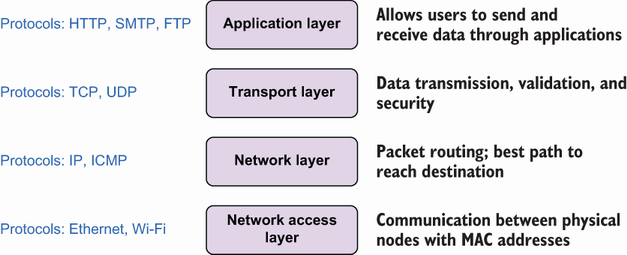
Figure 2.1 TCP/IP network model

Use the TCP/IP network model to locate the transport layer between the application layer and lower networking layers. section 2.1


How Rust Servers, Services, and Apps covers it

How deep it goes
Defines reliable byte-stream communication and demonstrates a basic TCP exchange, stopping short of application-message interpretation.
Examples
Uses a Rust TCP server and client that exchange a continuous stream of bytes before introducing HTTP handling.
What it assumes
Assumes familiarity with client-server communication while introducing the four-layer TCP/IP model and separating transport from application semantics.
What you can do after
Build a basic TCP client and server that exchange bytes using the Rust standard library.
How it connects
Connects TCP with the TCP/IP model, application layer, HTTP, and network access and internet layers.

Also explained in

Compare how 2 books explain transport layer →

Related concepts

This explainer was generated by Manning's knowledge graph from the text of Rust Servers, Services, and Apps. The section links point to the parts of the book it draws on.