liveBook · Manning

Trapdoor function

As explained in Hacking Cryptography

A trapdoor function is easy to compute but computationally difficult to invert without secret auxiliary information called a trapdoor.

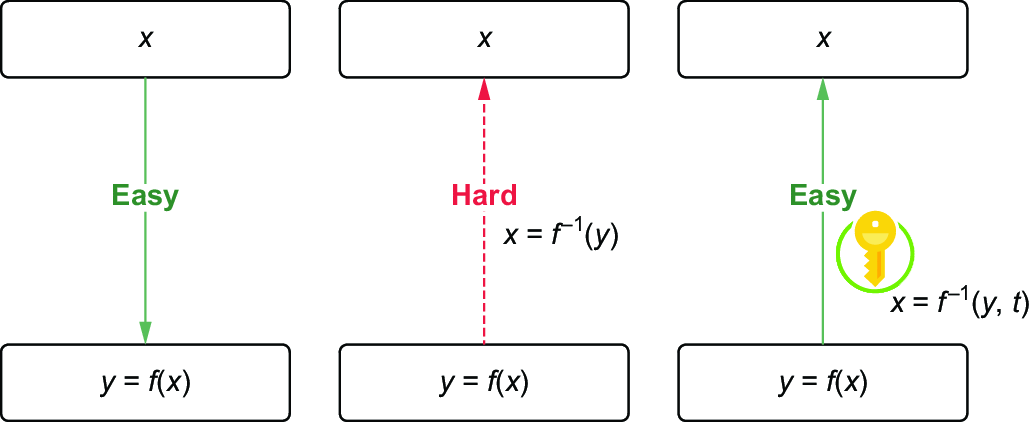
A trapdoor function is easy to compute in the forward direction, y = f(x), but computationally difficult to invert, x = f⁻¹(y), without secret auxiliary information t called the trapdoor. It provides the mathematical basis for asymmetric cryptography: public operations remain difficult to reverse without the private key. section 8.2.3 section 8.5

Easy down, hard back up

A dungeon trapdoor illustrates the asymmetry: anyone can fall through, but returning requires a key or special help. In RSA, multiplying two large primes p and q to produce n is easy when the factors are known; factoring n to recover p and q is computationally expensive without them. section 8.2.3 section 8.3.2

Figure 8.8 Mapping \(f\)’s range values to the domain is hard without special information \(t\).
figure

Maps the function’s range back to its domain and highlights why special information t is needed for practical inversion. section 8.2.3


How Hacking Cryptography covers it

How deep it goes
Defines forward computation and difficult inversion, then connects the idea to RSA factorization without developing other concrete functions.
Examples
Uses a dungeon trapdoor analogy and RSA multiplication-versus-factorization with large primes.
What it assumes
Assumes basic asymmetric cryptography and prime numbers while developing the trapdoor idea from an intuitive analogy.
What you can do after
Understand why public-key operations can be easy to perform yet difficult to reverse without a private key.
How it connects
Connects asymmetric cryptography with public-key cryptography, RSA, discrete logarithms, integer factorization, and prime numbers.

Also explained in

Compare how 2 books explain trapdoor function →

Related concepts

This explainer was generated by Manning's knowledge graph from the text of Hacking Cryptography. The section links point to the parts of the book it draws on.