A tree-based method is a machine-learning approach that learns relationships between input data and desired outputs, then uses those relationships to forecast demand. It is especially useful when planners need to identify which demand drivers matter, while recognizing that the model does not reveal relationships as clearly as traditional forecasting components. section 15.2 section 15.5
Use tree-based methods with these practical expectations:
- Inspect feature importance to identify potentially irrelevant demand drivers, but do not treat importance as the size or direction of an effect. section 15.1.2
- Run contrasting forecast scenarios, such as promotions versus no promotions, to estimate business effects that feature importance alone cannot explain. section 15.1.2
- Treat the model as a limited-visibility system: it will not directly expose level, trend, or seasonality in the way component-based forecasts can. section 15.1.2
Promotion scenarios
A demand planner compares forecasts with and without discounts. The scenarios indicate a 17% total uplift, while also showing lower sales before and after promotion periods because of self-cannibalization. section 15.1.2
Figure 15.2 Feature importance
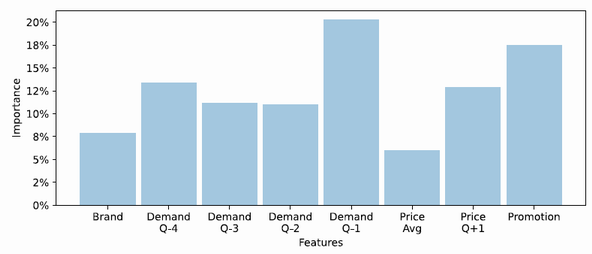
Use the feature-importance figure to see how tree-based models rank demand features and why ranking does not establish causal impact. section 15.1.2


