A decision tree node is a vertex that asks a yes-or-no question or returns a prediction. The root starts the process, branches carry answers, and leaves finish it. section 9.0
A node can play one of these roles:
- Root node: the topmost node containing the first question. section 9.0
- Decision node: a node with two branches that divides data according to a feature-based question. section 9.0 section 9.4
- Leaf node: a node with no branches that returns a prediction, often the majority label among its samples. section 9.4 section 9.13
From questions to predictions
To decide whether to wear a jacket, start with “Is it raining?” If not, ask whether it is cold. Each answer follows a branch until a leaf says “wear a jacket” or “do not wear a jacket.” A decision stump uses only the first question and two leaves. section 9.0
Figure 9.2 A regular decision tree with a root node, decision nodes, branches, and leaves. Note that each decision node contains a yes-or-no question. From each possible answer, one branch emanates, which can lead to another decision node or a leaf. This tree has a depth of 2, because the longest path from a leaf to the root goes through two branches.
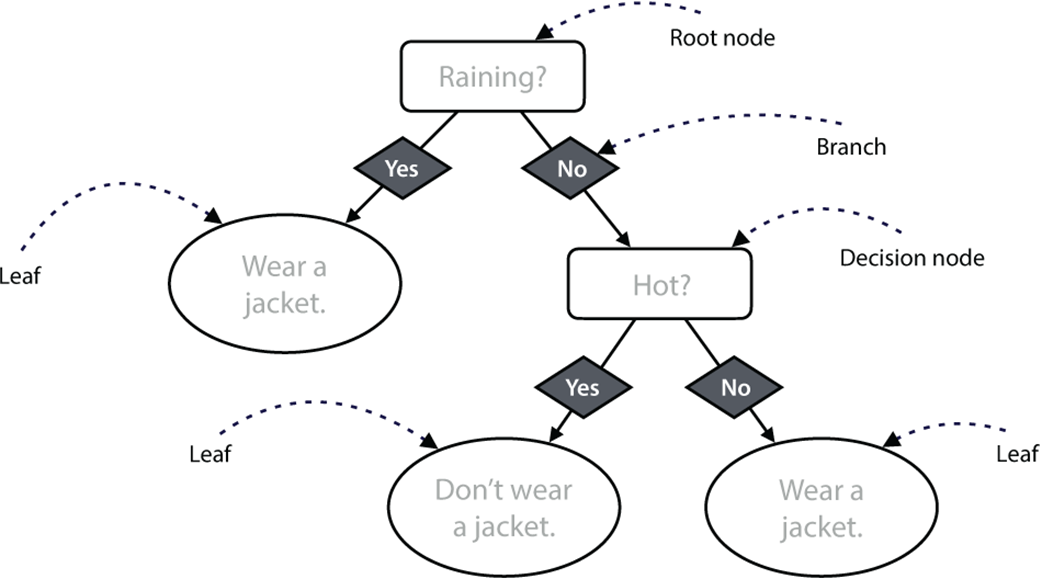
Use the tree diagram to trace questions from the root through branches to leaves and see how depth counts the longest root-to-leaf path. section 9.0
During training, a node is split when a feature improves classification. Stop splitting when the data is pure or when constraints such as maximum depth or minimum sample counts make the node a leaf. Scikit-Learn records entropy, sample count, and label counts at each node. section 9.4 section 9.11 section 9.13
