Tree-of-thought (ToT) explores alternative reasoning steps instead of committing to one chain. Chain-of-thought follows a single sequence; ToT grows several paths, evaluates partial solutions, drops weak branches, and can backtrack when a path fails. It is a search procedure for problems where looking ahead matters, such as planning, puzzles, and multi-move games. section 5.3.1
Think of each candidate step as a node in a tree:
- Generate several possible first steps. section 5.3.1
- Extend each candidate with further steps, then evaluate the resulting partial solutions. section 5.3.1
- Keep promising branches, prune weak ones, and return to another branch when needed. section 5.3.1
Figure 5.4 A partial workflow of the tree-of-thought process in which thoughts branch into nodes, and each node is executed to determine the best path to follow
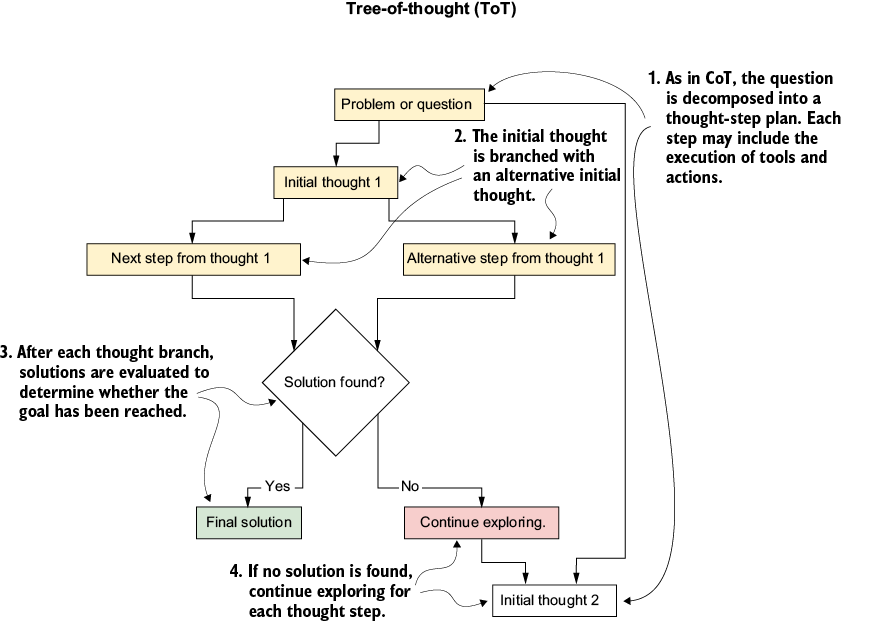
The diagram makes the difference from a single reasoning chain visible: candidate thoughts branch into nodes whose paths can be evaluated. section 5.3.1
A small branching exercise
Suppose a time machine must travel from 2025 toward 1800 using jumps of −100 or −30 years. A generator proposes possible first moves; an evaluator judges which partial plans look promising. To test deeper search, generate two initial candidates, extend each by two steps, score each branch from 0 to 10, and retain only scores of at least 7. Count the LLM calls as well as the branches kept: exploration has a cost, and a promising score is not proof that a destination is reachable. section 5.3.1 section 5.5
A prompt can ask for multiple candidates and scores, but a full ToT workflow also needs orchestration to prune and backtrack. Reserve it for tasks with meaningful branches and ways to evaluate them; simpler tasks rarely justify the extra calls and latency. A sequential-thinking tool can track thoughts, but it does not reason on its own. ToT can also be combined with step-by-step planning, tool use, and feedback loops. section 5.3.1 section 5.4.3 section 5.4.1





