Trino is an open-source, distributed SQL engine for high-performance analytics across diverse data environments. It targets read-heavy OLAP workloads rather than OLTP, providing one SQL interface for federating queries across lakehouses, relational databases, NoSQL systems, streaming platforms, and analytical stores. section 8.3.5 section 8.3
A coordinator parses and plans each query, then distributes stages, tasks, and splits across workers for parallel execution. Trino can push down filters, minimize data movement, and scale compute independently, making it effective for large or fragmented environments. section 8.3.5 section 8.3.7
Trino’s connector architecture supports:
- Independent catalogs configured for data lakes and lakehouses such as Iceberg, Delta Lake, Hudi, and Hive. section 8.3.6
- Connections to cloud storage, relational databases, warehouses, NoSQL stores, Kafka, and analytical systems. section 8.3.6
- Custom integrations through a service provider interface, allowing developers to add connectors for additional systems. section 8.3.6
Trino focuses on query execution and source connectivity, not native semantic modeling, data curation, or business-facing UI. Organizations needing governed metrics can pair it with tools such as Cube, AtScale, Select Star, or dbt Metrics, or use a commercial Trino platform with added capabilities. section 8.3.9 section 8.3
Deployment ranges from self-managed clusters on premises, virtual machines, or Kubernetes to managed offerings. Self-management preserves control but requires cluster operations and tuning; managed services reduce overhead. Trino Gateway can provide shared access, workload-aware routing, and cluster isolation. section 8.4.2 section 8.3.7
Choosing Trino for fragmented data
A company can query operational data across cloud platforms, relational databases, NoSQL systems, and flat files without first centralizing or replicating it. For occasional Hudi analysis in Amazon S3, AWS Athena provides serverless, pay-per-query access powered by Trino. section 8.5.1 section 8.5.4
Figure 8.9 Trino can connect to databases, data lakes, data warehouses, lakehouse catalogs, and streaming systems, making the results of federated queries accessible via REST API, JDBC, ODBC, and a variety of community-developed MCP servers.
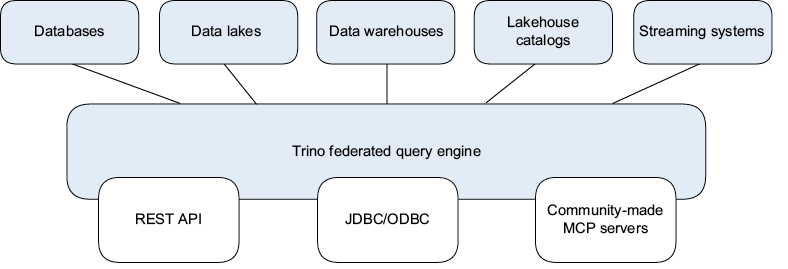
Map Trino’s federation surface across databases, data lakes, warehouses, lakehouse catalogs, streaming systems, and client access interfaces. section 8.3.6
