A Triton model repository packages each artifact–runtime pair in its own variant directory, giving the serving runtime a configuration alongside the model files. It makes deployment choices and runtime compatibility explicit rather than relying on the artifact alone. section 9.5
Repository layout
A variant follows `packages/<model>/triton_model_repo/<variant>/{1/, config.pbtxt}`. Example variants include `bert_sst2_ort_int8` and `bert_sst2_openvino_int8`. Configuration can specify input and output shapes, instance groups, and dynamic batching; precision is generally represented in the artifact graph, not the config. section 9.5
Figure 9.10 Packaging verification matrix on an NVIDIA L4 host. Rows are artifact kinds; columns are runtimes. Solid cells executed at the claimed precision (the OpenVINO Core CPU column reports per-op precision fractions; ORT cells verify load and run, since ORT's Python API does not expose per-op precision). Hatched cells loaded but fell back. ResNet INT8 × ORT TRT EP routed 19 nodes to CUDA EP because TensorRT's parser rejects ORT's INT32 zero-point format on Conv DQ; BERT INT8 × ORT CUDA EP is the 9.2 anti-pattern resurfacing. Filled cells are runtime, hardware, or artifact absent; information about the deploy target, not bugs.
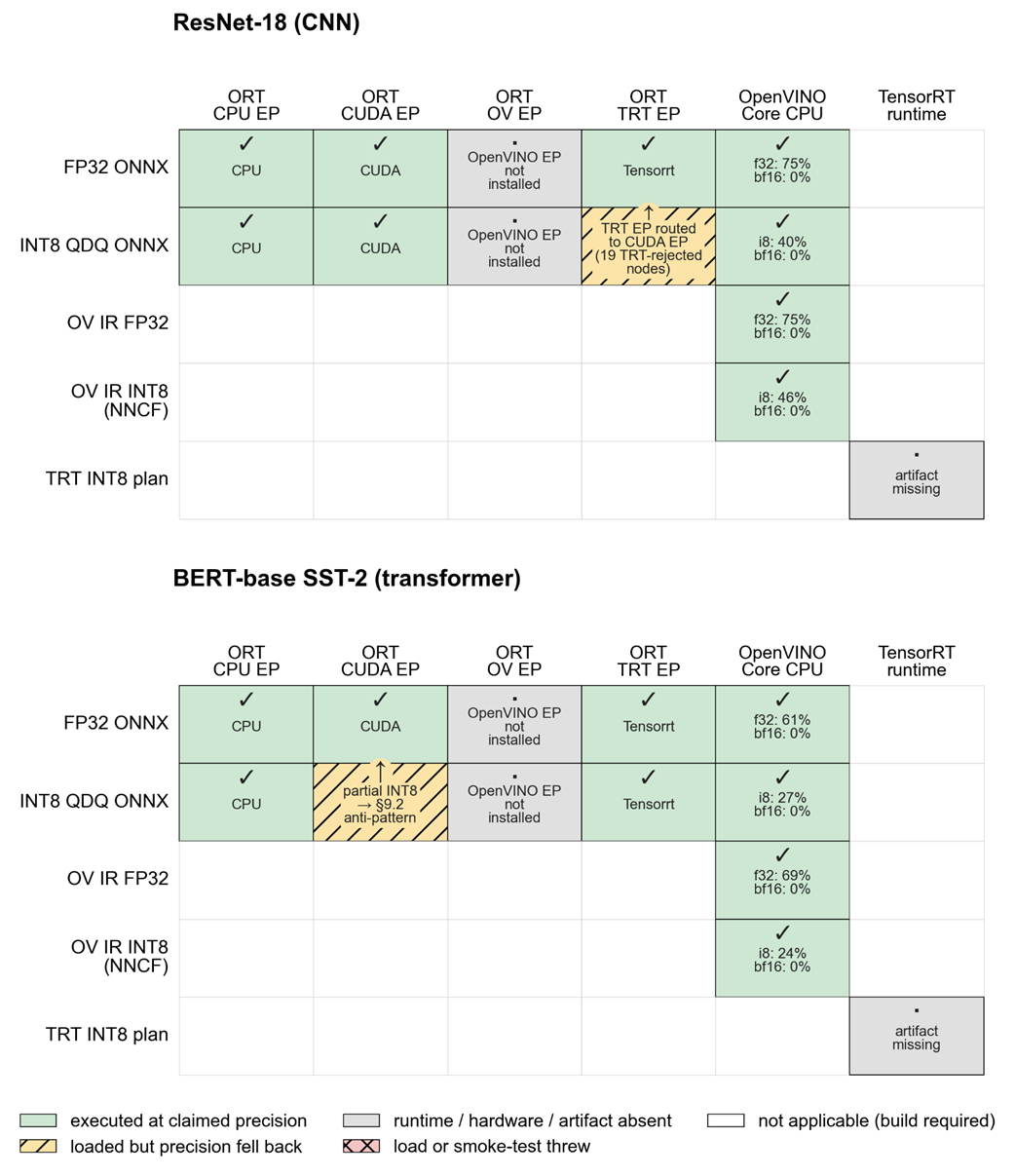
Compare artifact–runtime verification results across hardware hosts; the matrix distinguishes successful execution, fallback, and unavailable combinations. section 9.5
