liveBook · Manning

Autonomous bubble

As explained in Architecture Modernization: Socio-technical alignment of software, strategy, and structure

An autonomous bubble is a bounded context with independently owned persistence and reduced coupling to other models or contexts.

An autonomous bubble is a bounded context that owns its persistence and can evolve without breaking other contexts or a legacy model. It reduces coupling between both models and teams, making independent change possible. section 12.5

Adopt autonomy progressively:

  • Refactor code into a bounded context while temporarily retaining a shared database schema. section 12.5
  • Move the context to its own persistence schema when database coupling becomes the remaining migration risk. section 12.5
  • Publish domain events and use an anticorruption layer to translate changes for the legacy model. section 12.5

Gigs-platform modernization

A gigs platform separated job drafting and job fulfillment into new bounded contexts. A Job Published event was translated by an anticorruption layer into the legacy model, enabling A/B testing and gradual migration while existing functionality remained operational. section 12.5

Figure 12.29 Moving to an autonomous bubble to decouple from the legacy model using an event handler to update the legacy model with changes from the bounded context
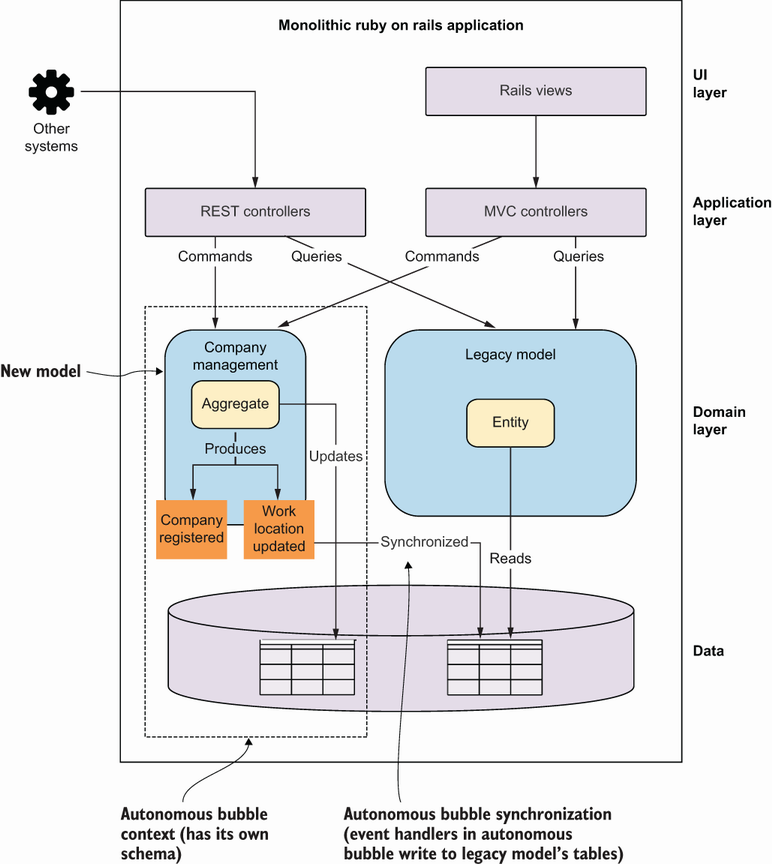
Shows the transition from a shared or legacy model to an autonomous bubble, including event-driven updates. section 12.5

How Architecture Modernization: Socio-technical alignment of software, strategy, and structure covers it

How deep it goes
Explains staged database decoupling, event translation, and controlled migration, but does not detail persistence implementation.
Examples
Uses job drafting, job fulfillment, Job Published events, and legacy job synchronization in a gigs platform.
What it assumes
Assumes bounded-context modeling and introduces persistence ownership through a staged modernization approach.
What you can do after
Enables teams to evolve bounded contexts independently and migrate legacy functionality through translated domain events.
How it connects
Connects bounded contexts, persistence schemas, domain events, anticorruption layers, and legacy models.

This explainer was generated by Manning's knowledge graph from the text of Architecture Modernization: Socio-technical alignment of software, strategy, and structure. The section links point to the parts of the book it draws on.