A data quantum is the smallest deployable data product that delivers value within a single domain. It packages interoperable data with discovery, governance, observability, onboarding, and control capabilities, making a focused alternative to an enterprise-wide data lake. section 14.2.2 section 14.3.2
Treat a data quantum as five coordinated subcomponents:
- Discovery and dictionary services expose passive metadata, descriptions, lineage, and access information. section 14.3.2
- Observability services expose availability, schema changes, and data-quality measures as active metadata. section 14.3.2
- Control services provide APIs for dataset versions, onboarding, storage, and data-quality rules. section 14.3.2
- Data onboarding brings source data into the quantum under controlled quality and lifecycle practices. section 14.3.2
- Interoperable data allows consumers and other data products to use the quantum as a composable unit. section 14.2.2 section 14.6
Start with six focused datasets
A small implementation used six datasets, each consisting of one table with fewer than 200 columns. Delivering this narrower product first produced value quickly, while leaving room to evolve features from customer feedback and a backlog. section 14.2.2 section 14.3.1
Figure 14.4 The data quantum takes the shape of a hexagon, highlighting its multiple endpoints, allowing access to data, metadata, observability, and control.
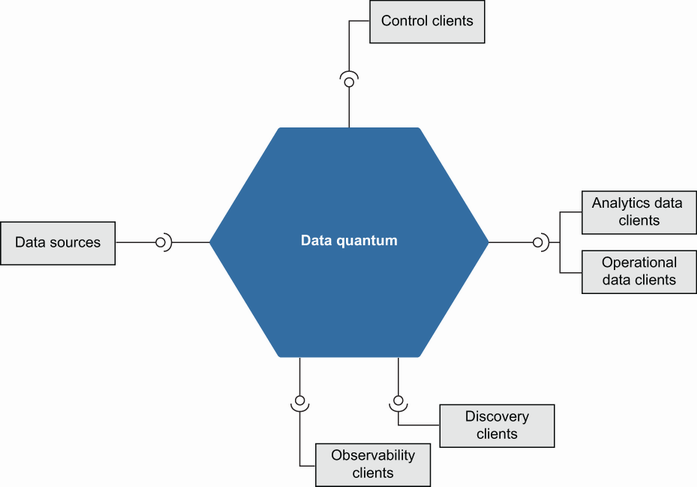
Use the hexagonal model to inspect the quantum through its data, metadata, observability, and control endpoints. section 14.2.2
Figure 14.7 A data quantum (pl. data quanta) is the implementation of a data product and is represented as a hexagon.
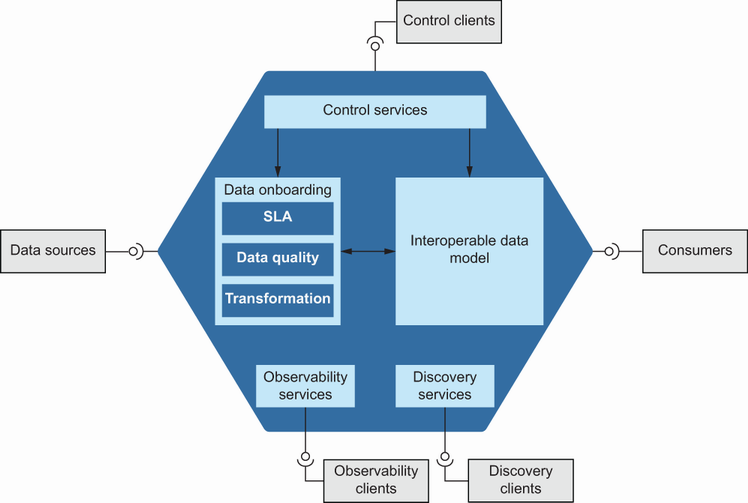
Use the logical architecture figure to relate the data product to its discovery, observability, control, onboarding, and interoperability capabilities. section 14.3.2
