A tutorial is a guided tour: a narrative explanation that walks through related concepts or product features in a meaningful sequence. It replaces a flat inventory with a learning path, starting with foundations and moving toward visible behavior or advanced features. section 3.0 section 8.3
The useful unit is not a file or endpoint but a concept a reader can hold in mind. A codebase tour identifies core abstractions, maps their relationships, and gives each abstraction a chapter. An API tour groups endpoints by user-named features instead of sorting them by path. section 3.1 section 8.3
Build a guided tour with a deliberate progression:
- Establish the overview before investigating implementation details; use one pass for structure and separate passes for component-level depth. section 3.6
- Order concepts by dependency or product importance, moving from foundational mechanisms toward visible interfaces and features. section 3.1
- Carry earlier explanations forward so later chapters can add transitions, cross-references, and a continuous narrative. section 3.4
- Demand concrete artifacts such as relationship diagrams, feature menus, dependency lists, or runtime traces rather than accepting a generic summary. section 3.0 section 7.8
From inventory to tour
A flat API list such as /admin/api-keys and /booking/create gives little orientation. A guided tour groups endpoints into features such as Catalog, Cart, Checkout, and Account, then walks through those groups from core functionality to less visible capabilities. For a schema, the same move turns dozens of tables into a narrative around a central User–EventType–Booking flow. section 8.3 section 7.8
Figure 3.1 For about $2 in API calls, the Codebase Knowledge Builder analyzes VS Code's 10,000 files to generate a 10-chapter tutorial, complete with dependency diagrams, cross-references, and a clear learning order.
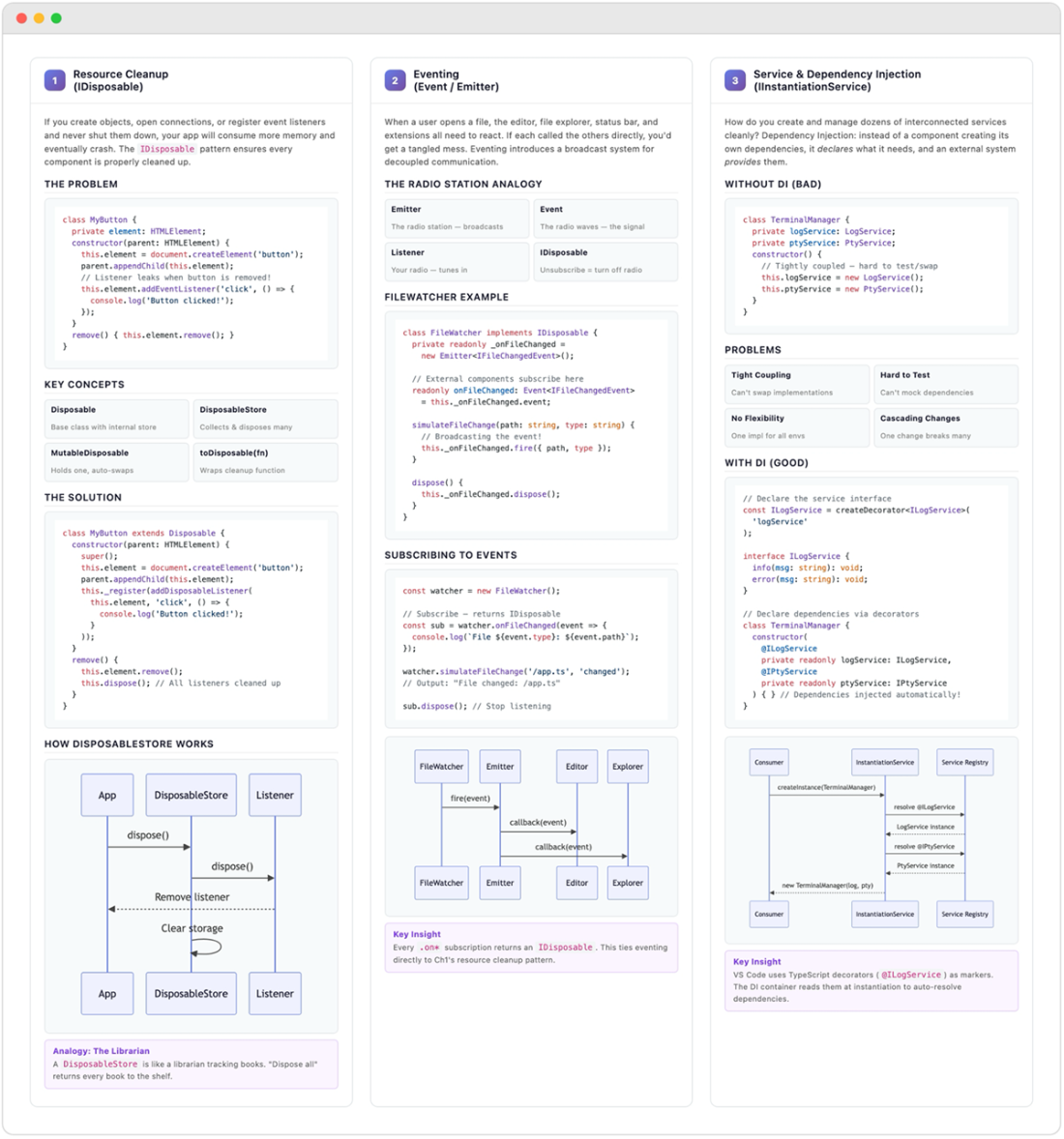
A generated multi-chapter tutorial can make a large repository navigable by combining core abstractions, dependency diagrams, cross-references, and a clear learning order. section 3.0
